
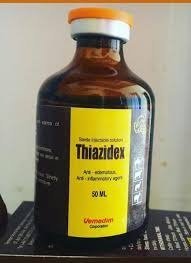
Thiazidex Injection 50mL – Powerful Advanced Veterinary Edema & Inflammation Support
Thiazidex Injection 50mL is a veterinary injectable formulation containing hydrochlorothiazide 50mg/mL and dexamethasone 0.5mg/mL. Available manufacturer information describes Thiazidex for managing certain forms of congestion and edema, including sheath edema and anasarca in horses, as well as specified edema-related conditions in cattle, sheep and camels.
The combination provides two different pharmacological actions: hydrochlorothiazide is a thiazide diuretic that promotes urinary elimination of sodium and water, while dexamethasone is a corticosteroid with anti-inflammatory activity. Because the product combines a diuretic and corticosteroid, veterinary assessment is important before administration.
What Is Thiazidex Injection 50mL?
Thiazidex Injection 50mL is a veterinary injectable solution supplied in a 50mL presentation. The manufacturer’s available product information identifies the formulation as:
| Ingredient | Strength per mL | Function |
|---|---|---|
| Hydrochlorothiazide | 50mg | Thiazide diuretic |
| Dexamethasone | 0.5mg | Corticosteroid / anti-inflammatory |
The product information identifies horses, cattle, sheep and camels among the intended animal species. For horses, listed applications include congestion and edema of different origins, sheath edema, anasarca and edema associated with allergic conditions.
Table of Contents
- What Is Thiazidex Injection 50mL?
- Thiazidex Injection for Horses
- Hydrochlorothiazide in Veterinary Care
- Dexamethasone and Inflammation
- Thiazidex for Equine Edema
- Thiazidex for Livestock
- Dosage and Administration
- Safety and Precautions
- Withdrawal Information
- Storage and Handling
- Where To Buy Thiazidex Injection 50mL Online
- Frequently Asked Questions
Thiazidex Injection for Horses
Thiazidex Injection 50mL is particularly relevant to equine-care professionals because manufacturer information lists its use in horses for several edema and congestion-related conditions.
Listed equine indications include:
- Congestion and edema of different origins
- Sheath edema
- Anasarca
- Edema associated with allergic conditions
Edema is the abnormal accumulation of fluid within tissues. In horses, swelling can occur for many different reasons, so the underlying cause should be identified before treatment.
A veterinarian may assess the horse’s:
- General condition
- Heart and respiratory function
- Hydration status
- Circulation
- Location and severity of swelling
- Recent injury or surgery
- Medication history
Hydrochlorothiazide in Veterinary Care
Hydrochlorothiazide is a thiazide diuretic. It increases the elimination of sodium and water through the kidneys, thereby promoting urine production.
In Thiazidex, this diuretic component works alongside dexamethasone.
Diuretic therapy can affect:
- Fluid balance
- Sodium levels
- Potassium levels
- Hydration
- Kidney function
- Blood pressure
Consequently, it should be used appropriately and under veterinary supervision.
Dexamethasone and Inflammation
Dexamethasone is a glucocorticosteroid with potent anti-inflammatory effects.
In Thiazidex, dexamethasone provides an anti-inflammatory component alongside the diuretic action of hydrochlorothiazide.
Corticosteroids can affect immune and metabolic processes, which means they should not be used indiscriminately. The veterinarian should determine whether corticosteroid therapy is appropriate for the underlying condition.
Thiazidex for Equine Edema
The manufacturer specifically lists sheath edema and anasarca among the equine indications for Thiazidex.
Anasarca refers to extensive generalized swelling caused by fluid accumulation. It can be associated with a variety of underlying conditions.
Likewise, sheath swelling can have multiple causes, and veterinary assessment is important when swelling is persistent, painful, severe or accompanied by other clinical abnormalities.
Thiazidex should therefore be considered part of a veterinary treatment strategy rather than a general-purpose swelling remedy.
Thiazidex for Livestock
Manufacturer information also describes Thiazidex for cattle, sheep and camels. Listed applications include certain cases of:
- Udder congestion and edema
- Persistent edema during lactation
- Pulmonary congestion and edema
- Edematous infiltration associated with surgical wounds
- Allergic edema
Food-producing animals require additional consideration because withdrawal requirements can apply.
Thiazidex Injection 50mL Dosage and Administration
Available manufacturer information states that horses, cattle and camels may receive Thiazidex by intramuscular or intravenous injection. It describes preventive and curative dosing protocols depending on the severity of congestion or edema.
However, the correct treatment should be determined by a veterinarian based on the specific animal, diagnosis and product labeling.
The 50mL vial size does not mean that the entire vial should be administered at once.
Because Thiazidex contains both a diuretic and a corticosteroid, inappropriate administration may result in complications involving fluid balance, electrolytes or corticosteroid-related effects.
Safety and Precautions
Veterinary supervision is especially important when treating animals with:
- Dehydration
- Kidney disorders
- Electrolyte abnormalities
- Cardiovascular disease
- Diabetes
- Existing infections
- Gastrointestinal disease
- Other corticosteroid therapy
- Other diuretic treatment
Possible complications can arise from excessive diuresis or inappropriate corticosteroid exposure.
Animals receiving treatment should be monitored for changes in hydration, appetite, urination, behavior and general condition.
Thiazidex and Other Medicines
Before administering Thiazidex Injection 50mL, tell the veterinarian about all medicines and supplements the animal is receiving.
This may include:
- Other diuretics
- Corticosteroids
- NSAIDs
- Antibiotics
- Heart medicines
- Kidney-related medicines
- Electrolyte supplements
- Other injectable products
Drug combinations can affect treatment safety and may require veterinary adjustment.
Withdrawal Information
The available manufacturer information specifies withdrawal periods for certain food-producing species.
It lists:
- Horses and camels: meat — 72 hours
- Cattle and sheep: meat — 72 hours
- Cattle and sheep: milk — 48 hours
Withdrawal requirements can differ according to jurisdiction and product registration, so the current local label should always take precedence.
Storage and Handling
Available product information states that Thiazidex should be stored at a temperature not exceeding 30°C, kept away from direct sunlight and protected from excessive heat.
Before administration, check:
- Expiration date
- Vial integrity
- Product appearance
- Correct concentration
- Storage conditions
- Species and indication
- Administration instructions
Do not use an injectable product if contamination or damage is suspected.
Where To Buy Thiazidex Injection 50mL Online
If you are looking to buy Thiazidex Injection 50mL online, verify the exact formulation before ordering. Available manufacturer information identifies the product as containing hydrochlorothiazide 50mg/mL and dexamethasone 0.5mg/mL.
Vet Pharma Med provides product information for customers researching veterinary medicines and animal-care products.
Before purchasing Thiazidex Injection 50mL, confirm:
- Product name
- 50mL presentation
- Active ingredients
- Concentrations
- Manufacturer
- Intended species
- Current product label
- Prescription requirements
- Storage instructions
- Local veterinary regulations
For international customers, applicable import, prescription and veterinary-medicine regulations should also be checked before ordering.
Frequently Asked Questions
What is Thiazidex Injection 50mL?
Thiazidex Injection 50mL is a veterinary injectable containing hydrochlorothiazide and dexamethasone. Manufacturer information describes its use for certain edema and congestion-related conditions.
What are the active ingredients in Thiazidex?
Each mL contains 50mg hydrochlorothiazide and 0.5mg dexamethasone, according to the available manufacturer information.
Is Thiazidex used for horses?
Yes. Manufacturer information lists horses among the target species and identifies several equine edema and congestion-related indications.
What is Thiazidex used for in horses?
Listed equine applications include congestion and edema of different origins, sheath edema, anasarca and edema associated with allergic conditions.
How is Thiazidex administered?
Available product information describes intramuscular or intravenous administration for horses, cattle and camels. A veterinarian should determine the appropriate route and treatment protocol.
What is the dosage of Thiazidex Injection 50mL?
The appropriate dosage depends on species, condition and severity. The manufacturer’s available information provides specific protocols, but treatment should be administered according to the current label and veterinary direction.
How should Thiazidex be stored?
Available information states that it should be stored at no more than 30°C, protected from sunlight and excessive heat.
Can Thiazidex be used in food-producing animals?
The manufacturer provides withdrawal information for cattle, sheep, horses and camels. Always follow the current local label and applicable regulatory requirements.
Thiazidex Composition:Each ml contains Hydrochlorothiazide……………. ……………. ……50 mg Dexamethasone………………………………….0.5 m Indications
Composition:Each ml contains:
Hydrochlorothiazide……………. ……………. ……50 mg
Dexamethasone………………………………….0.5 mg
Indications:
For horse:
– Congestion and edema of different origins.
– Sheath edema.
– Anasarca.
– Edema in allergic conditions.
For cattle, sheep, camels:
– Congestion and edema of udder.
– Persisting edema during lactation.
– Pulmotary congestion and edema.
– Edematous infiltration of surgical wounds.
– Edema in allergic conditions.
Dosage and direction for use:
Horse, cattle, camels: IM or IV.
– Preventive treatment : 10ml daily for 3 days.
– Curative treatment:
+ Congestion and light edema: 10ml daily for 2-3 days.
+ Congestions and severe edema: 20ml daily for 2 days and 10ml the 3rd day.
Sheep, foals and calves: 2ml/40-50 kg bw daily
Withdrawal time:
Horse, camel: Meat 72 hours.
Cattle, sheep: Meat: 72 hours; Milk: 48 hours.
Storage: Store at temperture not exeeding 30o C. Strictly keep away from
sunlight and avoid heat exposure.
THIAZIDEX 100 ml
Composition:
Each ml contains:
Hydrochlorothiazide……………. ……………. ……50 mg
Dexamethasone………………………………….0.5 mg
Indications:
For horse:
– Congestion and edema of different origins.
– Sheath edema.
– Anasarca.
– Edema in allergic conditions.
For cattle, sheep, camels:
– Congestion and edema of udder.
– Persisting edema during lactation.
– Pulmotary congestion and edema.
– Edematous infiltration of surgical wounds.
– Edema in allergic conditions.
Dosage and direction for use:
Horse, cattle, camels: IM or IV.
– Preventive treatment : 10ml daily for 3 days.
– Curative treatment:
+ Congestion and light edema: 10ml daily for 2-3 days.
+ Congestions and severe edema: 20ml daily for 2 days and 10ml the 3rd day.
Sheep, foals and calves: 2ml/40-50 kg bw daily
Withdrawal time:
Horse, camel: Meat 72 hours.
Cattle, sheep: Meat: 72 hours; Milk: 48 hours.
Storage: Store at temperture not exeeding 30o C. Strictly keep away from
sunlight and avoid heat exposure.
THIAZIDEX 100 ml
Composition:Each ml contains:
Hydrochlorothiazide……………. ……………. ……50 mg
Dexamethasone………………………………….0.5 mg
Indications
THIAZIDEX 100 ml
Composition:Each ml contains:
Hydrochlorothiazide……………. ……………. ……50 mg
Dexamethasone………………………………….0.5 mg
Indications

Reviews
There are no reviews yet.