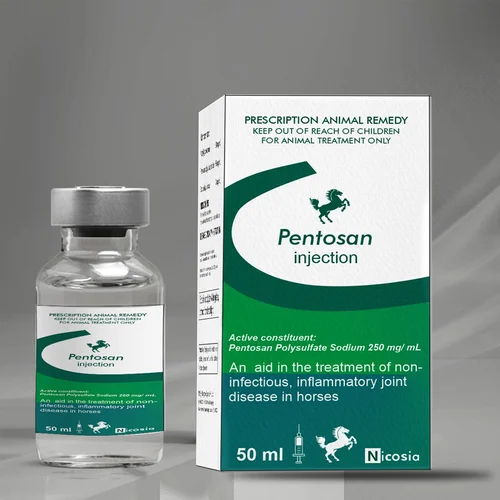
Pentosan Gold Injection 50ML for Horses
Pentosan Gold Injection 50ML is a veterinary equine joint-care product formulated with pentosan polysulfate sodium (PPS) and N-acetyl glucosamine (NAG). Current veterinary product information lists a concentration of 125 mg/mL pentosan polysulfate sodium and 200 mg/mL N-acetyl glucosamine for the 50 mL horse presentation.
Pentosan Gold is intended to be used as part of veterinary management for joint conditions in horses. Product information identifies applications including non-infectious inflammatory joint disease, osteoarthritis, osteochondrosis dissecans, and traumatic joint or peri-articular inflammation.
The 50 mL presentation is particularly relevant to horse owners, trainers, breeders and veterinary professionals looking for a pentosan-based injectable for an established equine joint-care program.
A horse’s joints are exposed to considerable mechanical demands throughout its life. This is especially true for racehorses and performance horses involved in jumping, dressage, eventing, endurance, polo, reining and other athletic disciplines. Appropriate joint management can therefore be an important component of maintaining comfortable movement and supporting an active horse.
Pentosan Gold should not, however, be viewed as a substitute for veterinary diagnosis. Lameness, stiffness, reduced performance or changes in gait can arise from numerous conditions involving joints, bones, tendons, ligaments, muscles, hooves or the back. A veterinarian should determine the underlying problem before an injectable joint product is incorporated into a treatment plan.
What Is Pentosan Gold Injection 50ML?
Pentosan Gold Injection 50ML is an injectable veterinary product specifically marketed for horses.
The product information available from veterinary pharmacies identifies two principal active components:
- Pentosan polysulfate sodium — 125 mg/mL
- N-acetyl glucosamine — 200 mg/mL
The product is supplied in a 50 mL vial.
The combination is designed around two areas of joint support. Pentosan polysulfate is associated with joint and cartilage management, while N-acetyl glucosamine is a glucosamine-derived compound involved in pathways associated with components of connective tissue and joint structures.
The exact label should always be checked before use because formulations with similar names may differ between manufacturers and countries.
Pentosan Gold 50ML Active Ingredients
Pentosan Polysulfate Sodium
Pentosan polysulfate sodium, commonly abbreviated PPS, is the principal pentosan component of Pentosan Gold.
It has been investigated and used in veterinary joint-care programs because of its biological effects on joint tissues and inflammatory processes.
Veterinary product information describes PPS as having anti-inflammatory and chondroprotective properties and associates it with mechanisms involving cartilage and synovial tissues.
N-Acetyl Glucosamine
The second major component listed for Pentosan Gold is N-acetyl glucosamine (NAG).
Glucosamine-related compounds are associated with the production and maintenance of glycosaminoglycans and other components involved in connective-tissue structures.
The combination of PPS and NAG is one of the distinguishing characteristics of this Pentosan Gold formulation.
Pentosan Gold for Equine Joint Care
Joint health is fundamental to a horse’s ability to move comfortably.
A horse’s joints contain several specialized structures that work together to permit smooth movement and distribute mechanical forces.
These include:
- Articular cartilage
- Synovial fluid
- Synovial membrane
- Joint capsule
- Subchondral bone
- Ligaments
- Supporting tissues
When a joint becomes inflamed or undergoes degenerative change, the horse may experience changes in comfort and movement.
Pentosan Gold is intended to be used within veterinary management of appropriate joint conditions rather than as a general-purpose performance product.
Pentosan Gold for Osteoarthritis in Horses
Osteoarthritis is one of the common chronic musculoskeletal problems encountered in horses.
It involves changes within the joint that can affect cartilage, bone, synovial tissues and other structures.
The condition can develop for different reasons, including previous injury, repetitive loading, conformation, age-related changes and other forms of joint stress.
Veterinary management is individualized.
Depending on the horse, treatment can involve:
- Exercise modification
- Weight management
- Farriery
- Rehabilitation
- Medication
- Joint therapies
- Nutritional management
- Monitoring
Pentosan Gold is listed for use as an aid in the treatment of osteoarthritis and other specified joint conditions in horses.
Pentosan Gold for Inflammatory Joint Disease
The product information identifies non-infectious inflammatory joint disease among its indications.
Joint inflammation can affect mobility and comfort.
However, inflammation can have many causes.
Infectious joint disease, for example, requires urgent veterinary attention and should not simply be treated as ordinary degenerative joint disease.
Correct diagnosis is therefore essential before choosing a joint-care approach.
Pentosan Gold and Osteochondrosis Dissecans
Osteochondrosis dissecans, commonly abbreviated OCD, is a developmental orthopedic condition affecting cartilage and bone.
It can occur in young horses and may influence athletic development and soundness.
Pentosan Gold product information specifically identifies osteochondrosis dissecans among its equine indications.
Because OCD can vary considerably between individual horses, veterinary assessment remains essential.
Pentosan Gold for Traumatic Joint Inflammation
Trauma can result in inflammation involving a joint or surrounding tissues.
Examples can include injury associated with exercise, accidents, falls or other mechanical events.
The appropriate management depends on the severity and exact location of the injury.
Pentosan Gold is listed as an aid in the management of traumatic joint and peri-articular inflammation.
A horse with acute swelling, significant lameness or severe pain should receive prompt veterinary assessment.
Pentosan Gold for Performance Horses
Performance horses place substantial demands on their musculoskeletal systems.
A racehorse experiences intense forces during high-speed exercise.
A jumper repeatedly absorbs landing forces.
An endurance horse works for prolonged periods.
A dressage horse performs repeated movements requiring balance, collection and controlled joint motion.
Because of these demands, joint health can become an important component of an overall performance-management program.
Pentosan Gold may be considered when a veterinarian identifies a suitable indication.
Pentosan Gold for Racehorses
Racehorses require careful management throughout training and competition.
Joint health can influence:
- Stride quality
- Comfort
- Training consistency
- Willingness to work
- Recovery
- Athletic longevity
However, an apparent performance problem should never automatically be attributed to joint disease.
Respiratory, cardiovascular, muscular, neurological, hoof and other orthopedic problems can produce similar changes.
A veterinary examination is therefore important when performance changes unexpectedly.
Pentosan Gold for Older Horses
Older horses may experience progressive changes in their joints.
Some remain comfortable and active for many years, while others develop mobility problems that require management.
Aging itself is not a diagnosis.
Veterinarians can evaluate the horse’s:
- Movement
- Body condition
- Joint health
- Hoof balance
- Exercise tolerance
- Medical history
and develop an appropriate management plan.
Pentosan Gold may be included in that plan where indicated.
Pentosan Gold and Mobility
Comfortable mobility is one of the most visible indicators of musculoskeletal health.
Owners may notice changes such as:
- Stiffness after rest
- Shorter strides
- Difficulty turning
- Reluctance to move
- Changes in jumping performance
- Reduced willingness to exercise
- Uneven gait
- Difficulty backing up
- Changes in posture
These signs should not be used to self-diagnose arthritis.
A veterinarian can determine whether the problem originates in a joint or another structure.
How Pentosan Polysulfate Relates to Joint Health
Pentosan polysulfate has several biological activities that have made it useful in veterinary joint-care discussions.
Veterinary product information describes effects involving inflammatory mediators, cartilage metabolism, synovial tissues and blood flow in joint-associated structures.
The purpose of explaining these mechanisms is to help horse owners understand why PPS is used in joint-management programs.
It should not be interpreted as a guarantee that every horse will experience the same response.
Individual outcomes depend on the underlying joint condition, severity, age, workload and other management factors.
Pentosan Gold and Cartilage Support
Articular cartilage helps create a smooth surface within a synovial joint.
It also distributes mechanical loads.
When cartilage becomes damaged or degenerative changes develop, joint function can be affected.
Maintaining a healthy joint environment is therefore an important part of long-term equine musculoskeletal care.
Pentosan Gold’s PPS component is described as having chondroprotective properties in product information.
Pentosan Gold and Synovial Function
Synovial fluid contributes to joint lubrication and helps create the environment required for healthy joint movement.
The quality and quantity of synovial fluid can influence joint function.
Product information for Pentosan Gold describes effects involving synovial fluid and hyaluronic acid synthesis.
This provides part of the rationale for its use in equine joint-care programs.
Pentosan Gold and N-Acetyl Glucosamine
N-acetyl glucosamine is a glucosamine derivative.
It is associated with pathways involved in the production of glycosaminoglycans and other structural components.
Pentosan Gold combines NAG with pentosan polysulfate, providing a formulation that approaches joint management through more than one active component.
Pentosan Gold and Long-Term Joint Management
Chronic joint conditions often require ongoing management rather than a single intervention.
A long-term program can include:
- Veterinary monitoring
- Appropriate exercise
- Rest periods
- Nutrition
- Weight management
- Hoof care
- Rehabilitation
- Joint-support therapies
The objective is to maintain comfortable movement and an appropriate quality of life while addressing the underlying condition.
Pentosan Gold can be one component of this type of individualized program.
Pentosan Gold and Exercise
Exercise should be adjusted to the horse’s physical condition.
A horse with active joint disease may need a different workload from a healthy performance horse.
Appropriate exercise can help maintain muscle strength and general fitness, while excessive or inappropriate loading may worsen musculoskeletal problems.
Veterinary rehabilitation advice can help determine the right balance.
Pentosan Gold and Weight Management
Body weight affects mechanical loading on the musculoskeletal system.
Maintaining a healthy body condition can therefore be particularly important for horses with joint problems.
Overweight horses may experience increased stress on their limbs and joints.
A veterinarian or qualified equine nutrition professional can help establish an appropriate feeding and weight-management plan.
Pentosan Gold and Hoof Balance
Hoof care is another important component of joint management.
Changes in hoof balance can alter limb mechanics and the distribution of forces.
Regular assessment by a qualified farrier, working alongside veterinary professionals when necessary, can help maintain appropriate hoof care.
No joint injection can compensate for consistently poor hoof management.
Pentosan Gold Administration
Because Pentosan Gold is a veterinary prescription product in some markets, administration should follow the exact product label and veterinary prescription.
A New Zealand veterinary pharmacy identifies the product as prescription-only and requires a veterinarian’s prescription.
Some online product pages describe specific administration schedules, but these should not be copied blindly because pentosan formulations differ.
For the exact Pentosan Gold 50ML formulation, the veterinarian should determine:
- Dose
- Frequency
- Route
- Treatment duration
- Maintenance schedule
- Monitoring requirements
Pentosan Gold 50ML Dosage
The product’s dosage should be based on the official label for the exact formulation and the veterinarian’s instructions.
This is particularly important because different products marketed as pentosan can contain different concentrations.
For example, current product information for Pentosan Gold 50ML lists 125 mg/mL PPS and 200 mg/mL NAG.
Another online listing provides different pentosan concentrations and should not be treated as interchangeable with the product above.
Therefore, the safest product-page wording is to instruct customers to follow their veterinarian’s prescribed regimen and the supplied label.
Pentosan Gold Storage
Current product information states that Pentosan Gold should be protected from sunlight and stored at temperatures not exceeding 25°C.
Always follow the storage instructions printed on the specific product packaging.
The vial should be checked before use for:
- Expiration
- Damage
- Contamination
- Unusual appearance
- Packaging integrity
Pentosan Gold Prescription Information
Pentosan Gold is identified as a restricted veterinary medicine requiring a prescription by at least one current veterinary pharmacy listing.
Requirements can differ by country.
Vet Pharma Med should therefore display the applicable prescription and regulatory information for the market in which the product is being offered rather than suggesting that veterinary prescription requirements are identical worldwide.
Pentosan Gold and Food-Producing Horses
One Australian regulatory document concerning the original NV Pentosan Gold Injection for Horses identifies a 50 mL pack size and states that it was not to be used in horses intended for human consumption.
This is an important distinction for product information.
The exact regulatory label applicable to the product being sold should always be checked because registrations and labeling can change.
Pentosan Gold Safety
Pentosan Gold should be used under veterinary supervision.
Available product information identifies precautions involving conditions such as clotting problems, traumatic hemorrhage, infection, renal or hepatic failure and periods around surgery.
These precautions make professional assessment particularly important before administration.
The veterinarian should know about other medicines and supplements the horse is receiving.
Pentosan Gold and Competition Regulations
Competition rules should always be checked before treating a racehorse or sport horse.
Veterinary medicines can be subject to medication-control requirements.
Different organizations and countries may have different rules concerning:
- Permitted substances
- Detection periods
- Withdrawal periods
- Treatment records
- Competition-day restrictions
A product page should never promise that Pentosan Gold is permitted in every competition.
Pentosan Gold for Horses in the USA
U.S. customers should verify the regulatory status of the exact Pentosan Gold formulation.
A product’s availability online does not establish FDA approval.
Where a product has not been verified as an FDA-approved formulation for the intended use, Vet Pharma Med should avoid making such a claim.
Pentosan Gold for Horses in Canada
Canadian customers should check applicable veterinary and import regulations.
The regulatory status of Pentosan Gold can differ from its status in another country.
Veterinary professionals should confirm whether the product is appropriate and legally obtainable for the intended use.
Pentosan Gold for Horses in Australia
Australia has specific veterinary medicine regulations administered through its relevant regulatory framework.
An APVMA publication documents an application for NV Pentosan Gold Injection for Horses, including a 50 mL pack size and an indication concerning non-infectious inflammatory joint disease.
Customers should nevertheless verify the current registration and label applicable to the exact product being purchased.
Pentosan Gold in Europe
Customers in France, Germany, Spain, the Netherlands and other European markets should verify their country’s veterinary medicine requirements.
Importation and prescription rules can vary.
International customers should not assume that a product’s status in Australia, New Zealand or the United States automatically applies to their own country.
Why Choose the 50ML Presentation?
The 50ML vial provides a larger presentation for veterinary joint-management programs.
The appropriate amount used per treatment depends on the exact formulation, horse and veterinarian’s prescribed regimen.
The number of treatments available from a vial should therefore not be assumed without knowing the prescribed volume and product concentration.
Pentosan Gold for Veterinary Joint-Care Programs
A comprehensive equine joint-care program may include several components.
Veterinary assessment
Regular examinations help identify changes in movement and joint health.
Exercise management
Workload should match the horse’s condition.
Nutrition
A balanced diet supports overall health and body condition.
Hoof care
Correct hoof management contributes to appropriate biomechanics.
Recovery
Adequate rest is important following demanding exercise.
Appropriate veterinary therapies
Where indicated, products such as Pentosan Gold can form part of the treatment plan.
Frequently Asked Questions
What is Pentosan Gold Injection 50ML?
Pentosan Gold Injection 50ML is a veterinary equine joint-care injection containing pentosan polysulfate sodium and N-acetyl glucosamine. Current product information lists 125 mg/mL PPS and 200 mg/mL NAG.
What is Pentosan Gold used for?
It is indicated in product information as an aid in the treatment of non-infectious inflammatory joint disease in horses, including osteoarthritis, osteochondrosis dissecans and traumatic joint or peri-articular inflammation.
Is Pentosan Gold for horses?
Yes. The 50 mL product is specifically marketed as an equine veterinary injection.
What are the active ingredients in Pentosan Gold 50ML?
The current veterinary product information I found lists pentosan polysulfate sodium 125 mg/mL and N-acetyl glucosamine 200 mg/mL.
Is Pentosan Gold the same as every other pentosan injection?
No. Pentosan formulations can differ in active ingredients and concentrations. Always check the exact product label.
Can Pentosan Gold be used for arthritis?
It is indicated as an aid in the treatment of osteoarthritis in horses according to current product information.
Does Pentosan Gold help horse mobility?
The product is intended for veterinary management of joint conditions that can affect mobility. Individual response varies and should be monitored by the veterinarian.
Is Pentosan Gold prescription-only?
At least one current veterinary pharmacy identifies Pentosan Gold as a restricted veterinary medicine requiring a prescription. Requirements vary by country.
How should Pentosan Gold be administered?
The veterinarian should determine the route and treatment schedule based on the exact product label and the horse’s condition.
How much Pentosan Gold should a horse receive?
The correct dose should come from the official label and the prescribing veterinarian. Different pentosan products have different concentrations.
How should Pentosan Gold 50ML be stored?
Current product information states that it should be protected from sunlight and stored at temperatures not exceeding 25°C. Always follow the actual package label.
Can Pentosan Gold be used in competition horses?
It may be prescribed for appropriate veterinary indications, but competition and medication regulations must be checked before treatment.
Can Pentosan Gold be used in horses intended for human consumption?
This depends on the exact product registration and label. An APVMA document for NV Pentosan Gold Injection for Horses states that it was not to be used in horses intended for human consumption.
Is Pentosan Gold a steroid?
No. The formulation described above contains pentosan polysulfate sodium and N-acetyl glucosamine rather than a corticosteroid.
Is Pentosan Gold an antibiotic?
No. It is a joint-care product rather than an antibiotic.
Pentosan Gold Injection 50ML — Vet Pharma Med
Pentosan Gold Injection 50ML is a specialized veterinary product for equine joint care, containing pentosan polysulfate sodium and N-acetyl glucosamine. Current veterinary product information identifies the formulation as 125 mg/mL pentosan polysulfate sodium and 200 mg/mL N-acetyl glucosamine in a 50 mL presentation.
The combination is designed for veterinary management of joint conditions in horses. Product information identifies non-infectious inflammatory joint disease, osteoarthritis, osteochondrosis dissecans and traumatic joint or peri-articular inflammation among its applications.
Pentosan polysulfate is associated with several biological actions relevant to joint health, including effects involving inflammatory processes, cartilage metabolism and synovial tissues. N-acetyl glucosamine provides an additional component associated with connective-tissue and joint-support pathways. Together, these ingredients provide the basis for Pentosan Gold’s role within an equine joint-care program.
For racehorses, sport horses, older horses and animals experiencing veterinary-diagnosed joint problems, maintaining comfortable movement can be an important part of overall health and performance management. Joint care should nevertheless be approached comprehensively. Veterinary assessment, appropriate exercise, nutrition, hoof care, weight management, rehabilitation and sufficient recovery can all contribute to better long-term musculoskeletal management.
Pentosan Gold should be used according to the exact product label and veterinary prescription. This is especially important because pentosan products sold under similar names can have different concentrations and administration instructions. Current product information confirms that the 50 mL Pentosan Gold formulation is a restricted veterinary medicine in some markets.
Storage requirements should also be followed carefully. Current product information states that Pentosan Gold should be protected from sunlight and stored at temperatures not exceeding 25°C.
Horse owners should also consider competition regulations before using the product in racing or regulated equestrian sport. Medication rules differ between jurisdictions and organizations, so professional veterinary guidance and current competition regulations should always be consulted.
For international customers searching for Pentosan Gold Injection 50ML for horses, Pentosan Gold 50ML, Pentosan Gold Equine Injection, Pentosan Gold for horse arthritis, Pentosan Gold for equine joint care and related product information, Vet Pharma Med can provide a clear resource focused on the actual product, its formulation and responsible veterinary use.
The most important consideration is that Pentosan Gold should be part of a carefully designed veterinary management program rather than a substitute for diagnosis. When a horse develops lameness, stiffness, reduced performance or changes in movement, identifying the cause is essential. Once the veterinarian has assessed the horse, an appropriate joint-care strategy can be developed around the individual animal’s condition, workload and long-term needs.
Pentosan Gold Injection 50ML therefore represents a targeted option for veterinary equine joint management, with its combination of pentosan polysulfate sodium and N-acetyl glucosamine providing a formulation specifically associated with joint health and mobility support.
Pentosan gold is a sterile solution formulated as an aid in the treatment of noninfectious inflammatory joint disease in horses. It is indicated as an aid in the treatment of non-infectious, inflammatory joint disease in the horse. Clinical applications include the following conditions: osteoarthritis, osteochondritis dissecans (OCD), traumatic joint and periarticular inflammation. If used in performance animals, the regulations of the relevant authorities regarding medication should be observed. It is used to treat pain/ discomfort from a certain bladder disorder (interstitial cystitis). It may work by forming a layer on the bladder wall and protecting it from harmful/irritating substances in the urine. pentosan gold
• Anti-inflammatory activity
• Inhibition of neutrophil migration into the joint. pentosan gold
• Stimulation of hyaluronic acid synthesis by synovial fibroblasts, resulting in increased volume and viscosity of synovial fluid.
• Stimulation of proteoglycan synthesis by chondrocytes.
• Fibrinolytic activity, resulting in improved circulation to subchondral bone and periarticular structures.
is a sterile solution formulated as an aid in the treatment of noninfectious inflammatory joint disease in horses. It is indicated as an aid in the treatment of non-infectious, inflammatory joint disease in the horse. Clinical applications include the following conditions: osteoarthritis, osteochondritis dissecans (OCD), traumatic joint and periarticular inflammation. If used in performance animals, the regulations of the relevant authorities regarding medication should be observed. It is used to treat pain/ discomfort from a certain bladder disorder (interstitial cystitis). It may work by forming a layer on the bladder wall and protecting it from harmful/irritating substances in the urine.
Anti-inflammatory activity
Inhibition of neutrophil migration into the joint.
Stimulation of hyaluronic acid synthesis by synovial fibroblasts, resulting in increased volume and viscosity of synovial fluid.
Stimulation of proteoglycan synthesis by chondrocytes.
Fibrinolytic activity, resulting in improved circulation to subchondral bone and periarticular structures


Reviews
There are no reviews yet.