
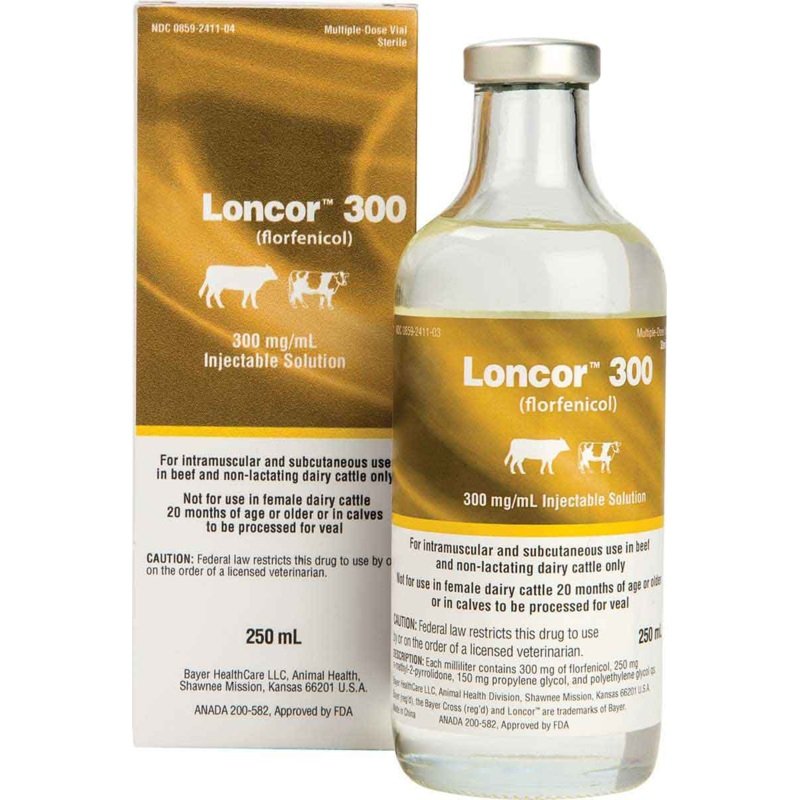
Buy Loncor 300 / Florfenicol Injectable Solution) Veterinary Broad-Spectrum Anti-Infective Therapeutics: The Definitive Guide to Bovine Pharmacology, Antimicrobial Kinetics, and Clinical Management
Managing severe bovine respiratory disease ($\text{BRD}$), shipping fever complexes, bovine interdigital necrobacillosis (foot rot), and infectious keratoconjunctivitis (pinkeye) in cattle herds requires a high-potency, broad-spectrum synthetic antimicrobial that achieves sustained tissue concentrations without relying on older classes of antibiotics. When livestock suffer from aggressive pneumonic pathogens, consolidation of lung lobes, or systemic bacterial invasion, targeted parenteral antimicrobial intervention is essential to halt bacterial protein synthesis, eradicate infection foci, and restore herd health.
Left unmanaged, bovine respiratory disease and systemic bacterial infections lead to irreversible lung tissue necrosis, severe production losses, diminished weight gain, and high mortality rates.
Relying solely on short-acting bacteriostatic agents or conventional antibiotics frequently fails to penetrate tough bovine tissue barriers or maintain minimum inhibitory concentrations ($\text{MIC}$) over extended multi-day windows.
To provide targeted, long-acting antimicrobial defense backed by veterinary clinical standards, modern cattle production relies on high-concentration florfenicol formulations. Loncor 300 ($300\ \text{mg/mL}$ Florfenicol Injectable Solution) is a premier, professional-grade parenteral anti-infective formulated to deliver extended-release bacteriostatic and bactericidal efficacy against major bovine respiratory and systemic bacterial pathogens.
Antimicrobial Pharmacology & Bacterial Inhibition Kinetics
Loncor 300 delivers a targeted biochemical mechanism engineered to bind bacterial ribosomes and halt essential protein synthesis:
          [Loncor 300 Injectable Solution Administered (Subcutaneous or Intramuscular)]
                                              |
                   [Rapid Systemic Absorption and High Sustained Lung Tissue Penetration]
                                              |
               [Penetration Across Bacterial Cell Membrane into Cytoplasm]
                                              |
               -------------------------------------------------
              |                                                 |
     [BINDING TO 50S RIBOSOMAL SUBUNIT]          [INHIBITION OF PEPTIDYL TRANSFERASE]
   (Attaches Specifically to Bacterial Ribosomes) (Blocks Amino Acid Chain Elongation During Translation)
              |                                                 |
              v                                                 v
     [HALTING OF PROTEIN SYNTHESIS]              [BPT / BACTERIOSTATIC & BACTERICIDAL ACTION]
   (Stops Essential Bacterial Enzyme Production) (Inhibits Growth and Eradicates Susceptible Pathogens)
              |                                                 |
              v                                                 v
     [Resolution of Pneumonic Consolidation]     [Eradication of Foot Rot & Pinkeye]
   (Clears Mannheimia, Pasteurella, & Histophilus)(Restores Normal Herd Vitality and Peak Production)
              |                                                 |
               =========================> <=====================
                                              |
                                              v
                   [Complete Systemic Microbiological Cure and Pulmonary Recovery]
                                              |
                   [Elimination of Infection, Rapid Clinical Recovery, & Peak Livestock Vigor]
1. Mechanism of Action and Molecular Structure
Florfenicol is a synthetic broad-spectrum fluorinated derivative of chloramphenicol. It exerts its antimicrobial activity by binding to the 50S ribosomal subunit of susceptible bacteria, specifically inhibiting the enzyme peptidyl transferase. This prevents amino acid chain elongation during protein translation, effectively halting bacterial protein synthesis, cellular growth, and replication across both Gram-positive and Gram-negative pathogens.
2. Pharmacokinetic Profile
-
Prolonged Systemic Persistence: Rapidly absorbed following subcutaneous or intramuscular administration, establishing high and sustained therapeutic concentrations in blood plasma and infected lung tissue for up to 48 hours or longer per dose.
-
Broad Tissue Distribution: Reaches high concentrations in cerebrospinal fluid, ocular fluids, respiratory secretions, and deep soft tissue abscesses.
Primary Clinical Indications
Loncor 300 Injectable Solution is utilized across specialized bovine veterinary clinical protocols for:
-
Bovine Respiratory Disease ($\text{BRD}$ / Shipping Fever): Treatment of bovine respiratory disease associated with Mannheimia haemolytica, Pasteurella multocida, and Histophilus somni.
-
Control of BRD in High-Risk Herds: Metaphylactic administration in beef calves entering feedlots experiencing high environmental stress or exposure to $\text{BRD}$.
-
Bovine Foot Rot: Treatment of acute interdigital necrobacillosis (foot rot) caused by Fusobacterium necrophorum and Bacteroides melaninogenicus.
-
Infectious Bovine Keratoconjunctivitis ($\text{IBK}$ / Pinkeye): Management of pinkeye outbreaks associated with Moraxella bovis.
Recommended Administration and Dosing Protocols
To guarantee absolute sterility, exact dosage calculation, and safe parenteral delivery in cattle, Loncor 300 must be administered strictly according to approved veterinary prescribing guidelines.
Dosing Reference Table
The table below outlines standard operational parameters for Loncor 300 Injectable Solution:
| Parameter | Operational Specification |
| Vial Concentration | High-potency solution containing $300\ \text{mg}$ of Florfenicol per $1\ \text{mL}$ |
| Subcutaneous Regimen (Single Dose) | $40\ \text{mg/kg}$ ($2\ \text{mL}$ per $15\ \text{lbs}$ / $3\ \text{mL}$ per $100\ \text{lbs}$) body weight given once subcutaneously |
| Intramuscular Regimen (Split Dose) | $20\ \text{mg/kg}$ ($1\ \text{mL}$ per $33\ \text{lbs}$) body weight given twice, exactly 48 hours apart |
| Primary Administration Routes | Subcutaneous ($\text{SC}$) in the neck (preferred) or Intramuscular ($\text{IM}$) |
| Target Species | Beef cattle, dairy replacement heifers, and feedlot livestock |
Clinical Safety, Precautions, and Storage
-
Slaughter Withdrawal Compliance: Observe established mandatory meat and milk withdrawal periods following treatment to ensure complete human food safety compliance. Not authorized for use in female dairy cattle of breeding age ($20$ months of age or older).
-
Breeding Bull Precaution: Use with caution in breeding bulls; adverse effects on testicular weight and sperm motility have been observed at elevated doses.
-
Storage Parameters: Store at controlled room temperature between 15°C and 30°C (59°F and 86°F). Protect from direct sunlight and freezing. Keep vial tightly stoppered.
Frequently Asked Questions (FAQ)
What is the active ingredient in Loncor 300?
Each milliliter contains Florfenicol ($300\ \text{mg/mL}$), a broad-spectrum synthetic fluorinated broad-spectrum antibiotic.
How is Loncor 300 typically administered to cattle?
It can be administered either as a single subcutaneous injection ($40\ \text{mg/kg}$) in the neck or as two intramuscular injections ($20\ \text{mg/kg}$) spaced 48 hours apart.
Why is florfenicol effective against shipping fever?
It binds directly to the 50S bacterial ribosomal subunit, inhibiting peptidyl transferase and halting bacterial protein synthesis, which rapidly clears pulmonary pathogens like Mannheimia haemolytica.
Where can I buy genuine Loncor 300 online?
You can safely source authentic, pharmaceutical-grade Loncor 300 Injectable Solution online through Vet Pharma Med. We store all specialized veterinary anti-infectives under rigorous climate-controlled conditions to guarantee absolute product freshness, safety, and full potency.
Secure Professional Sourcing from Vet Pharma Med
At Vet Pharma Med, we understand that managing severe bovine respiratory disease, treating foot rot, and ensuring precise livestock anti-infective therapy require uncompromising product purity and strict quality control. Every unit of Loncor 300 ($300\ \text{mg/mL}$) is procured through authorized distribution networks, stored in our climate-controlled facility, and dispatched with precision.
For prescription verifications, professional accounts, or logistics tracking assistance, please reach out to our support desk directly at equinesvet@gmail.com.
Loncor 300 (Florfenicol) Injectable Solution for Cattle is an antibiotic indicated for the treatment of bovine respiratory disease (BRD) and foot rot, and for the control of respiratory disease in cattle at high risk for developing BRD in beef and non-lactating dairy cattle. Each ml of BRD antibiotic, Loncor 300 Injectable Solution, contains 300 mg florfenicol and can be administered subcutaneously or intramuscularly. For treatment of BRD or foot rot, the recommended dosage is 3 ml per 100 lbs. body weight, given by IM injection. A second dose should be given 48 hours later. Alternatively, Loncor 300 can be administered once by SQ injection of 6 ml per 100 lbs. For control of respiratory disease in cattle at high risk for BRD, administer 6 ml per 100 lbs., given SQ in the neck. Do not administer more than 10 ml per injection site. The injection should be given only in the neck. For use in beef and non-lactating dairy cattle only. Not for use in female dairy cattle 20 months of age or older, including dry dairy cows. Do not use in calves to be processed for veal. Florfenicol.
BRD Treatment – Loncor 300 Injectable Solution is indicated for treatment of bovine respiratory disease (BRD), associated with Mannheimia haemolytica, Pasteurella multocida, and Histophilus somni.
Foot Rot Treatment – Loncor 300 Injectable Solution is indicated for the treatment of bovine interdigital phlegmon (foot rot, acute interdigital necrobacillosis, infectious pododermatitis) associated with Fusobacterium necrophorum and Bacteroides melaninogenicus.
BRD Control – Loncor 300 Injectable Solution is also indicated for the control of respiratory disease in cattle at high risk of developing BRD associated with Mannheimia haemolytica, Pasteurella multocida, and Histophilus somni.
Reviews
There are no reviews yet.