
Draxxin 100mg/mL Injection: The Definitive Guide to Tulathromycin Macrolide Therapy, Pharmacokinetics, and Clinical Management
Managing acute bacterial infections, bovine respiratory disease ($\text{BRD}$), swine respiratory disease ($\text{SRD}$), and infectious keratoconjunctivitis across livestock operations requires a high-potency, long-acting parenteral macrolide antibiotic. When large animal populations experience acute respiratory pathogen exposure or environmental stress, prompt intervention with a single-dose broad-spectrum antimicrobial is essential to control morbidity, limit mortality, and prevent herd-level outbreaks.
Left unmanaged, respiratory tract infections and complex bacterial syndromes lead to severe lung consolidation, irreversible tissue damage, systemic sepsis, and significant economic loss.
Relying on short-acting daily treatments frequently increases handling stress, labor costs, and the risk of missed therapeutic windows in large-scale production environments.
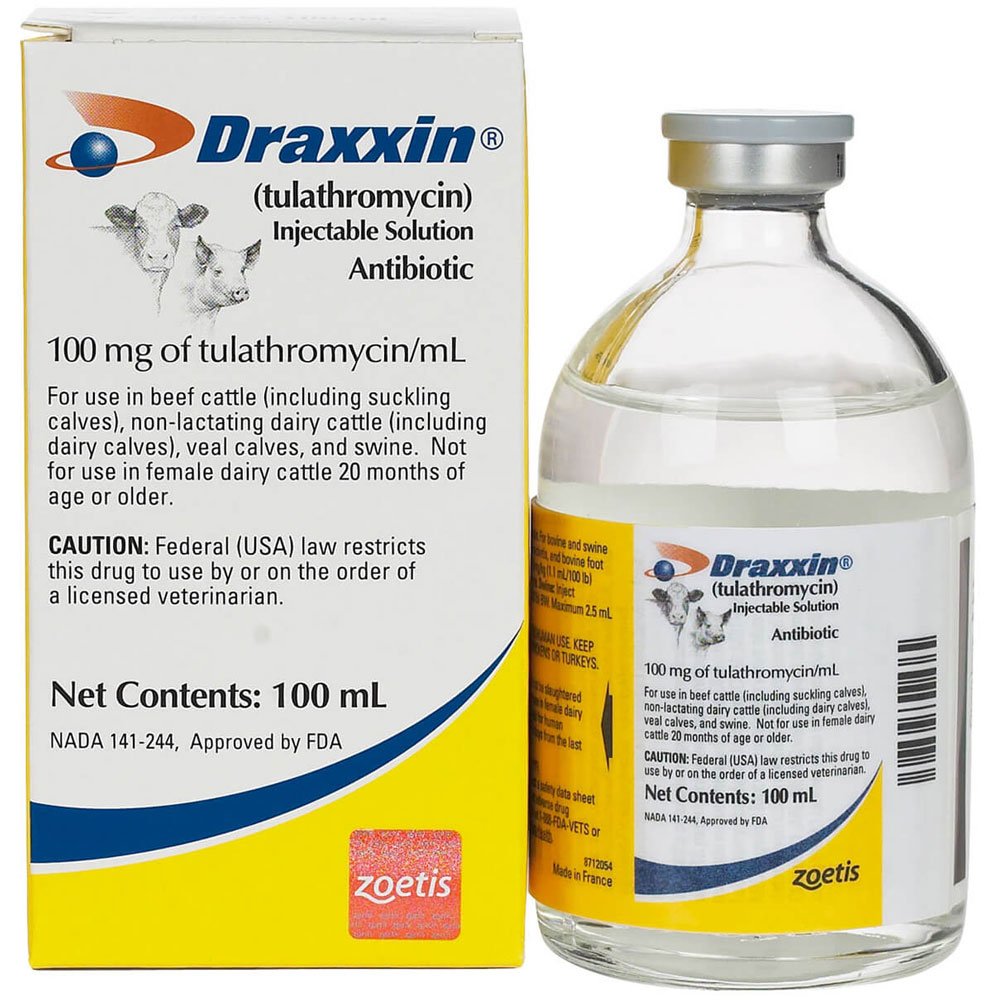
To provide sustained, single-dose tissue concentration backed by rigorous veterinary clinical validation, practitioners rely on gold-standard triamilide formulations. Draxxin 100mg/mlInjection ($100\ \text{mg/mL}$) (manufactured by Zoetis) is a premier, professional-grade anti-infective formulation powered by Tulathromycin at a concentration of $100\ \text{mg/mL}$. Packaged in multi-dose glass vials, Draxxin delivers targeted, long-acting bactericidal activity designed specifically for comprehensive livestock health management.
Macrolide Pharmacology & Kinetic Profile
Draxxin delivers a targeted biochemical mechanism engineered to inhibit bacterial protein synthesis and maintain prolonged therapeutic concentrations directly in target tissues:
                  [Draxxin 100mg/mL Injection Administered (SC in Cattle / IM in Swine)]
                                              |
                   [Rapid Systemic Absorption and Extensive Tissue Distribution]
                                              |
               [Selective Concentration in Lung Parenchyma and Infection Focus]
                                              |
               -------------------------------------------------
              |                                                 |
     [INHIBITION OF PROTEIN SYNTHESIS]           [EXTENDED TERMINAL ELIMINATION HALF-LIFE]
   (Binds 50S Ribosomal Subunits of Pathogens)  (Maintains Therapeutic Levels up to 9 Days)
              |                                                 |
              v                                                 v
   [Rapid Bactericidal Action]                 [Suppression of Respiratory Pathogens]
   (Eradicates Mannheimia, Pasteurella, etc.)  (Prevents Pathogen Recurrence & Relapse)
              |                                                 |
              v                                                 v
   [Systemic Clearance via Liver and Kidneys]  [Single-Dose Convenience]
   (Safe Elimination Profile Over Time)        (Reduces Animal Handling & Stress)
              |                                                 |
               =========================> <=====================
                                              |
                                              v
                   [Complete Eradication of Target Bacterial Load & Systemic Pathogens]
                                              |
                   [Restored Herd Health, Normal Respiratory Rate, & Optimized Performance]
1. Mechanism of Action and Triamilide Structure
Tulathromycin is a semi-synthetic macrolide antibiotic belonging to the subclass triamilide, possessing three basic amine groups that confer unique pharmacokinetic properties. It acts by binding to bacterial 50S ribosomal subunits, thereby inhibiting essential protein synthesis and halting the replication of susceptible Gram-negative and Gram-positive pathogens.
2. Pharmacokinetic and Lung-Targeting Kinetics
-
Rapid Absorption and Distribution: Absorbed quickly following subcutaneous or intramuscular administration, distributing extensively into body tissues with a massive volume of distribution.
-
High Lung Tissue Concentration: Tulathromycin concentrates heavily within respiratory tissue and neutrophils, achieving concentrations in lung homogenate significantly higher than concurrent plasma levels.
-
Extended Half-Life: Features a prolonged terminal elimination half-life (often lasting several days in target tissues), providing a full course of therapeutic protection from a single administration.
Primary Clinical Indications
Draxxin 100mg/mL Injection is indicated across key livestock sectors for the control and treatment of complex bacterial conditions:
-
Bovine Respiratory Disease ($\text{BRD}$): Treatment and metaphylaxis of $\text{BRD}$ associated with Mannheimia haemolytica, Pasteurella multocida, Histophilus somni, and Mycoplasma bovis in beef and non-lactating dairy cattle.
-
Swine Respiratory Disease ($\text{SRD}$): Treatment and control of $\text{SRD}$ associated with Actinobacillus pleuropneumoniae, Pasteurella multocida, Bordetella bronchiseptica, and Mycoplasma hyopneumoniae in pigs.
-
Infectious Bovine Keratoconjunctivitis ($\text{IBK}$): Treatment of pinkeye associated with Moraxella bovis in cattle.
-
Bovine Foot Rot: Treatment of interdigital necrobacillosis associated with Fusobacterium necrophorum and Porphyromonas levii.
Recommended Administration and Dosing Protocols
To guarantee absolute safety, proper bioavailability, and tissue compatibility, Draxxin 100mg/ml must be administered strictly according to approved route and weight-based guidelines.
Dosing Reference Table
The table below outlines standard operational parameters for Draxxin 100mg/mL Injection:
| Target Species | Administration Route | Standard Dosage Rate | Volume Equivalent | Maximum Volume Per Site |
| Cattle (Beef & Non-Lactating Dairy) | Subcutaneous ($\text{SC}$) in neck | $2.5\ \text{mg/kg}$ body weight | $1\ \text{mL}$ per $40\ \text{kg}$ ($1.1\ \text{mL}$ per $100\ \text{lbs}$) | $10\ \text{mL}$ per site |
| Swine (Pigs) | Intramuscular ($\text{IM}$) in neck | $2.5\ \text{mg/kg}$ body weight | $1\ \text{mL}$ per $40\ \text{kg}$ ($0.25\ \text{mL}$ per $10\ \text{kg}$) | $2.5\ \text{mL}$ per site |
Clinical Safety, Precautions, and Storage
-
Withdrawal Periods: Observe mandatory pre-slaughter withdrawal intervals (typically varying by region and species—e.g., 18 days in cattle, 33 days in pigs) prior to marketing meat for human consumption. Do not use in female dairy cattle 20 months of age or older.
-
Injection Site Reactions: Subcutaneous administration in cattle and intramuscular administration in swine commonly cause transient local tissue reactions (such as swelling, congestion, or fibrosis) that can persist for up to 30 days and may require trimming at slaughter.
-
Storage Parameters: Store unopened glass vials at controlled room temperatures between 15°C and 25°C (59°F to 77°F) with excursions permitted up to 30°C. Protect from direct sunlight.
Frequently Asked Questions (FAQ)
What is the active ingredient in Draxxin 100mg/ml Injection?
Draxxin 100mg/ml contains Tulathromycin ($100\ \text{mg/mL}$), a broad-spectrum triamilide macrolide antibiotic.
Is Draxxin administered as a multi-day or single dose?
Draxxin 100mg/ml is engineered as a single-dose therapy, providing sustained therapeutic tissue levels for up to 9 days from one administration.
Can Draxxin 100mg/ml be used in dairy cattle?
It is approved for use in beef cattle, suckling calves, veal calves, and non-lactating dairy cattle, but it must not be used in female dairy cattle 20 months of age or older.
Where can I buy genuine Draxxin 100mg/ml Injection online?
You can safely source authentic, pharmaceutical-grade Draxxin 100 mg/mL Injection online through Vet Pharma Med. We store all veterinary antimicrobial inventory under rigorous climate-controlled conditions to guarantee absolute product freshness, safety, and full potency.
Secure Professional Sourcing from Vet Pharma Med
At Vet Pharma Med, we understand that managing livestock respiratory health and controlling acute infection outbreaks requires absolute product reliability and rigorous cold-chain standards. Every vial of Draxxin 100mg/mlInjection is sourced through authorized veterinary distribution channels, stored in our climate-controlled facility, and handled with precision.
For prescription verifications, veterinary clinic wholesale accounts, or logistics tracking assistance, please reach out to our professional support desk directly at our contact us page.
Draxxin 100mg/ml Injection A clear aqueous ready to use solution containing tulathromycin 100 mg/ml.Cattle: Treatment and prevention of bovine
Draxxin 100mg/ml Injection A clear aqueous ready to use solution containing tulathromycin 100 mg/ml.Cattle: Treatment and prevention of bovine respiratory disease associated with Mannheimia (Pasteurella) haemolytica, Pasteurella multocida, Mycoplasma bovis and Histophilus somni sensitive to tulathromycin. The presence of the disease in the herd should be established before preventative treatment. Treatment of infectious bovine keratoconjunctivitis (IBK) associated with Moraxella bovis sensitive to tulathromycin.
Pigs: Treatment and prevention of swine respiratory disease (SRD) associated with Actinobacillus pleuropneumoniae, Pasteurella multocida, Mycoplasma hyopneumoniaeand Haemophilus parasuis sensitive to tulathromycin. The presence of the disease in the herd should be established before preventative treatment. Draxxin should only be used if pigs are expected to develop the disease within 2-3 days.
Legal Category: POM-V
Dosage:
Cattle Draxxin 100mg/ml Injection
A single subcutaneous injection of 2.5 mg tulathromycin/kg body weight (equivalent to 1 ml/40 kg body weight). For treatment of cattle over 300 kg bodyweight, divide the dose so that no more than 7.5 ml are injected at one site.
Pigs Draxxin 100mg/ml Injection
A single intramuscular injection of 2.5 mg tulathromycin/kg body weight (equivalent to 1 ml/40 kg body weight) in the neck. For treatment of pigs over 80 kg bodyweight, divide the dose so that no more than 2 ml are injected at one site.
It is recommended to treat animals in the early stages of the disease and to evaluate the response to treatment within 48 hours after injection. If clinical signs of respiratory disease persist or increase, or if relapse occurs, treatment should be changed, using another antibiotic, and continued until clinical signs have resolved.
To ensure correct dosage body weight should be determined as accurately as possible to avoid underdosing.
Cattle Draxxin 100mg/ml Injection
A single subcutaneous injection of 2.5 mg tulathromycin/kg body weight (equivalent to 1 ml/40 kg body weight). For treatment of cattle over 300 kg bodyweight, divide the dose so that no more than 7.5 ml are injected at one site.
Pigs Draxxin 100mg/ml Injection
A single intramuscular injection of 2.5 mg tulathromycin/kg body weight (equivalent to 1 ml/40 kg body weight) in the neck. For treatment of pigs over 80 kg bodyweight, divide the dose so that no more than 2 ml are injected at one site.
It is recommended to treat animals in the early stages of the disease and to evaluate the response to treatment within 48 hours after injection. If clinical signs of respiratory disease persist or increase, or if relapse occurs, treatment should be changed, using another antibiotic, and continued until clinical signs have resolved


Reviews
There are no reviews yet.