
Shop Entyce Oral Solution 30mg/mL for Dogs 15mL Online
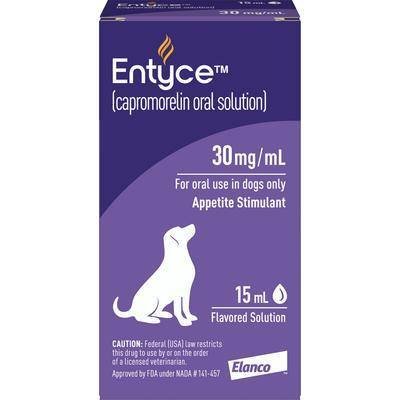
Entyce Oral Solution 30mg/mL for Dogs 15mL is a prescription veterinary appetite stimulant containing capromorelin. It is formulated specifically for oral use in dogs and is indicated for appetite stimulation in dogs. The product is supplied as a flavored 30mg/mL oral solution, with the 15mL presentation supplied with a measuring syringe for administration.
Entyce works differently from conventional nutritional supplements. Its active ingredient, capromorelin, is a selective ghrelin receptor agonist. According to the current U.S. product labeling, capromorelin binds to receptors involved in signaling in the hypothalamus to stimulate appetite and also binds to the growth hormone secretagogue receptor in the pituitary gland, increasing growth hormone secretion.
Loss of appetite can occur for many reasons in dogs, including illness, recovery from medical procedures, chronic disease, gastrointestinal problems, dental problems and other conditions. Entyce is intended to address reduced appetite as part of veterinary management; it does not replace investigation and treatment of the underlying reason a dog is eating poorly.
The current U.S. label recommends administration orally at 3mg/kg (1.4mg/lb) once daily, according to veterinary direction. The label also states that effectiveness was not evaluated beyond four days of treatment in its clinical field study.
Entyce is FDA-approved under NADA #141-457, and the current labeling identifies it as a prescription animal drug. Federal law restricts its use to or on the order of a licensed veterinarian.
What Is Entyce for Dogs?
Entyce is a veterinary oral solution formulated to stimulate appetite in dogs.
Its active pharmaceutical ingredient is capromorelin tartrate, with the product providing 30mg of capromorelin tartrate per mL of solution. The product is manufactured for Elanco US Inc. and is available in 10mL, 15mL and 30mL bottle sizes.
The 15mL bottle is particularly useful for customers and veterinary patients requiring the smaller available presentation.
Entyce should not be confused with a nutritional supplement or ordinary food additive. It is a prescription veterinary drug with a specific pharmacological action.
Entyce 30mg/mL
The concentration of Entyce Oral Solution is 30mg/mL.
This concentration allows the veterinarian to prescribe a measured volume according to the dog’s body weight.
The product should always be measured accurately using the supplied dosing syringe or another appropriate measuring device recommended by the veterinary professional.
Using household teaspoons or other uncalibrated utensils can make accurate dosing more difficult.
Entyce 15mL Bottle
The 15mL presentation contains flavored Entyce oral solution and is supplied with a measuring syringe. The current product information identifies the 15mL package under NDC 58198-5535-2.
The bottle size does not determine the appropriate dose for a dog.
The amount administered depends on the veterinarian’s prescription and the dog’s body weight.
Because Entyce is supplied in multiple bottle sizes, customers should make sure that the product ordered matches the prescription and the amount required for the intended treatment period.
Capromorelin for Dogs
Capromorelin is the active ingredient in Entyce.
It belongs to a group of compounds known as ghrelin receptor agonists.
Ghrelin is a naturally occurring hormone involved in appetite regulation and other physiological processes. Capromorelin interacts with the relevant receptor system to stimulate appetite.
This pharmacological mechanism distinguishes Entyce from simply offering a more appealing food.
For dogs experiencing reduced appetite, stimulating the desire to eat can be an important component of supportive veterinary care while the underlying medical issue is being addressed.
How Entyce Works
The current label describes Entyce as a selective ghrelin receptor agonist.
Capromorelin binds to receptors involved in appetite signaling in the hypothalamus. It also interacts with growth hormone secretagogue receptors in the pituitary gland.
The appetite-stimulating effect is the primary reason Entyce is prescribed.
This means the product is intended to help encourage food intake rather than directly treating an infection, parasite, inflammatory disease, kidney disorder, dental condition or other underlying cause of appetite loss.
That distinction is important when discussing Entyce with pet owners.
Entyce for Dogs With Poor Appetite
Poor appetite is a clinical sign rather than a diagnosis.
A dog may stop eating because of:
- Dental discomfort
- Gastrointestinal disease
- Pain
- Medication effects
- Stress
- Infection
- Chronic disease
- Recovery after illness
- Recovery following a procedure
- Metabolic abnormalities
- Other medical conditions
A veterinarian may therefore recommend diagnostic testing or additional treatment alongside an appetite stimulant.
Entyce can be incorporated into a broader veterinary treatment plan when appropriate.
Entyce and Veterinary Care
An appetite stimulant should not be used to mask an unresolved medical problem.
If a dog suddenly stops eating, especially if the loss of appetite is accompanied by vomiting, diarrhea, weakness, pain, dehydration, breathing difficulties or other concerning signs, veterinary evaluation is important.
The underlying problem may require treatment beyond appetite stimulation.
Entyce is most appropriately viewed as one component of veterinary management rather than a replacement for diagnosis.
Entyce Dosage for Dogs
The current U.S. product label recommends:
3mg/kg (1.4mg/lb) orally once daily.
Because Entyce contains 30mg/mL, the veterinarian can calculate the appropriate volume based on the dog’s body weight.
For safety, owners should use the dose specifically prescribed by their veterinarian.
Do not independently increase the dose because a dog has not eaten enough.
Do not administer additional doses outside the prescribed schedule without professional advice.
How to Administer Entyce
The current label provides the following administration procedure:
- Gently shake the bottle.
- Remove the bottle cap.
- Insert the supplied dosing syringe firmly into the bottle opening.
- Turn the bottle upside down.
- Withdraw the prescribed volume.
- Return the bottle to an upright position before removing the syringe.
- Replace the bottle cap.
- Administer the solution into the dog’s mouth.
- Rinse the syringe and plunger with water between treatment doses.
- Leave the syringe and plunger apart to dry.
- Wash hands immediately after use.
Following the manufacturer’s administration instructions helps ensure that the intended amount of medicine is delivered.
Entyce Appetite Stimulant
Entyce is specifically labeled as an appetite stimulant for dogs.
The FDA approval information identifies its indication as appetite stimulation in dogs.
This makes it different from products designed to treat a specific infectious disease or inflammatory condition.
When a dog has poor appetite, the veterinarian may determine that encouraging food intake is appropriate while simultaneously managing the underlying illness.
When Veterinarians May Consider Entyce
Veterinarians may consider appetite stimulation when a dog has reduced or absent appetite and the clinical situation makes increased food intake desirable.
The clinical field study for Entyce included dogs with various medical conditions, including arthritis, gastrointestinal disease, allergy, dental disease, cardiovascular disease and renal disease.
This does not mean Entyce treats those diseases.
Rather, the study demonstrates that the product was evaluated in dogs presenting with reduced appetite in the context of various underlying conditions.
Entyce and Senior Dogs
Older dogs may experience appetite changes for many reasons.
Dental disease, chronic illness, gastrointestinal changes, medication effects and other age-associated conditions can influence eating behavior.
If an older dog becomes reluctant to eat, veterinary assessment can help identify the underlying cause.
Where appropriate, Entyce may form part of the veterinarian’s plan to encourage food intake.
Entyce During Recovery
Reduced appetite can occur during recovery from illness or other medical events.
Adequate nutrition and hydration are important components of recovery, but the appropriate feeding strategy depends on the individual patient.
A veterinarian may recommend Entyce when appetite stimulation is appropriate.
The product should be used according to the prescribed treatment plan rather than simply being administered whenever a dog refuses a meal.
Entyce and Gastrointestinal Conditions
Dogs with gastrointestinal problems can experience reduced appetite.
Possible signs may include:
- Vomiting
- Diarrhea
- Nausea
- Abdominal discomfort
- Reduced food intake
If a gastrointestinal condition is responsible for poor appetite, treating that underlying condition remains important.
Entyce may help stimulate appetite when prescribed, but it is not itself a general treatment for every gastrointestinal disorder.
Entyce and Dental Problems
Dental disease can make eating uncomfortable.
A dog may appear interested in food but hesitate to eat, chew differently or drop food.
In such cases, an appetite stimulant does not address the underlying dental problem.
Veterinary dental evaluation may be necessary.
Entyce should therefore be used as directed within a broader treatment strategy when appropriate.
Entyce and Chronic Disease
Dogs with chronic illnesses may experience changes in appetite over time.
Veterinary management may involve medication, diet modification, laboratory monitoring and supportive care.
If appetite declines, the veterinarian can determine whether capromorelin is appropriate.
The decision should take into account the dog’s complete medical history and current medications.
Entyce for Dogs With Kidney Problems
The current label advises using Entyce with caution in dogs with renal insufficiency. It states that approximately 37% of capromorelin is excreted in urine and 62% in feces.
Owners should tell the veterinarian if their dog has known kidney disease.
Veterinary monitoring may be particularly important for dogs with reduced kidney function.
The veterinarian may determine whether Entyce is appropriate and whether additional monitoring is needed.
Entyce and Liver Problems
The product label advises caution when Entyce is used in dogs with hepatic dysfunction.
Capromorelin is metabolized by CYP3A4 and CYP3A5 enzymes.
A veterinarian should therefore know about any diagnosed liver disease or abnormal liver-function results before prescribing the product.
Entyce and Heart Disease
The current label advises caution in dogs that may have cardiac disease.
Entyce can cause transient decreases in heart rate and blood pressure following administration, and some dogs may show clinical signs associated with bradycardia or hypotension.
Dogs with known or suspected heart disease should therefore be managed carefully by a veterinarian.
Entyce and Dehydration
The product label also recommends caution in dogs with severe dehydration.
A dog that is not eating may also have reduced water intake.
Owners should monitor hydration and seek veterinary advice when a dog has persistent appetite loss, particularly when accompanied by vomiting, diarrhea or weakness.
Entyce and Diabetes
The current product label advises caution in dogs with diabetes mellitus because hyperglycemia has been reported following administration.
Dogs with diabetes should therefore only receive Entyce under veterinary supervision.
The veterinarian can determine whether appetite stimulation is appropriate and whether blood glucose monitoring should be adjusted.
Entyce Side Effects
The clinical field study reported several adverse reactions in dogs receiving Entyce.
Reported reactions included:
- Diarrhea
- Vomiting
- Hypersalivation
- Abdominal discomfort
- Flatulence
- Nausea
- Increased thirst
- Lethargy or depression
- Elevated blood urea nitrogen
- Elevated phosphorus
- Elevated creatinine
The frequencies varied among reactions.
Not every dog experiences these reactions.
Owners should contact their veterinarian if a dog develops significant, persistent or concerning symptoms.
Entyce and Vomiting
Vomiting was reported among adverse reactions in the controlled clinical field study.
If a dog vomits after receiving Entyce, owners should not automatically repeat the dose.
Whether another dose is appropriate depends on the circumstances, including when vomiting occurred and the veterinarian’s treatment plan.
Contacting the prescribing veterinarian is the safest approach.
Entyce and Diarrhea
Diarrhea was also reported in the clinical field study.
If diarrhea develops or worsens, owners should monitor the dog closely and contact the veterinarian when symptoms are persistent, severe or accompanied by other concerning signs.
Dogs with significant diarrhea can become dehydrated, making veterinary assessment particularly important.
Entyce and Increased Thirst
Polydipsia, or increased thirst, was among the reactions reported in the controlled study.
An increase in water consumption may also be associated with the underlying disease, other medications or environmental factors.
A veterinarian can help determine whether a change is medication-related or requires additional investigation.
Entyce and Lethargy
Lethargy or depression was reported in a small percentage of dogs receiving Entyce in the clinical field study.
A dog with an underlying illness may also naturally become lethargic.
If lethargy is severe, sudden or worsening, veterinary attention is appropriate.
Entyce Contraindications
Entyce should not be used in dogs with a known hypersensitivity to capromorelin.
The veterinarian should be informed about any previous allergic or hypersensitivity reaction to capromorelin.
Entyce for Pregnant or Breeding Dogs
The current product labeling states that the safe use of Entyce has not been evaluated in dogs used for breeding or in pregnant or lactating bitches.
Owners should tell their veterinarian if the dog is pregnant, lactating or intended for breeding.
The veterinarian can determine whether an alternative approach is more appropriate.
Entyce for Puppies
Entyce is labeled for dogs, but the suitability of treatment for a particular puppy should be determined by a veterinarian.
Age, weight, underlying disease and overall health can affect the treatment decision.
Owners should not assume that an appetite stimulant intended for dogs is appropriate for every puppy without veterinary evaluation.
Entyce Is Not for Cats
The Entyce formulation is labeled for dogs only.
There is a separate capromorelin product, Elura, formulated for cats at 20mg/mL and carrying a separate feline indication.
Therefore, Entyce 30mg/mL should not be substituted for a feline product without veterinary direction.
Entyce Versus Elura
Both products contain capromorelin, but they are different veterinary products.
Entyce: 30mg/mL, for dogs, indicated for appetite stimulation.
Elura: 20mg/mL, for cats, with separate labeling for feline use.
Because the concentrations and labeled species differ, owners should never interchange the products on their own.
Entyce Storage
The current U.S. label states that Entyce should be stored at or below 86°F (30°C).
Keep the bottle properly closed when not in use.
The medication should be kept away from children and animals that could accidentally ingest it.
The manufacturer also specifically warns that the drug and used syringes should be kept out of reach of dogs, cats and other animals to prevent accidental ingestion or overdose.
Entyce Safety for People
Entyce is intended for dogs and should not be used by humans.
The current label warns that it is not for human use and advises keeping the medicine and used syringes away from children. It also states that the product may be absorbed through the skin and recommends washing hands immediately after use.
If accidental human ingestion occurs, medical advice should be sought.
Entyce and Accidental Overdose
Accidental ingestion or administration of an excessive amount can be dangerous.
Owners should keep the bottle and dosing syringe securely stored.
If a dog accidentally receives more Entyce than prescribed, contact the veterinarian promptly for advice.
Do not administer another dose until the appropriate instructions have been obtained.
Entyce and Other Medicines
The veterinarian should be told about every medicine, supplement and veterinary product the dog receives.
This includes:
- Prescription medicines
- Over-the-counter products
- Vitamins
- Nutritional supplements
- Herbal products
- Other appetite stimulants
A complete medication history helps the veterinarian evaluate the treatment plan.
Entyce Prescription Status
Entyce is a prescription animal drug.
The current U.S. labeling states that federal law restricts the product to use by or on the order of a licensed veterinarian.
This should be clearly communicated on a product page.
Entyce FDA Approval
Unlike some products whose regulatory status can be unclear, the current official labeling states that Entyce is approved by FDA under NADA #141-457.
The FDA’s historical Green Book information records the original approval for Entyce on May 16, 2016, for appetite stimulation in dogs.
Entyce 15mL Product Details
| Product detail | Information |
|---|---|
| Brand | Entyce |
| Active ingredient | Capromorelin tartrate |
| Concentration | 30mg/mL |
| Form | Flavored oral solution |
| Bottle size | 15mL |
| Species | Dogs |
| Indication | Appetite stimulation |
| Route | Oral |
| Dose on current U.S. label | 3mg/kg once daily |
| Prescription | Yes |
| FDA application | NADA #141-457 |
| Manufacturer | Elanco US Inc. |
| Storage | At or below 86°F (30°C) |
Product details are based on the current U.S. labeling.
Why Choose the 15mL Entyce Presentation?
The 15mL bottle is one of the available Entyce presentations and is supplied with a measuring syringe.
For customers whose veterinarian has prescribed Entyce, the 15mL size can provide a convenient option where the smaller package is appropriate.
The correct package size depends on the prescribed dose, treatment duration and veterinary recommendation.
The 15mL bottle should not be selected solely on the basis of price or bottle size.
Entyce for Dogs: Important Buying Considerations
When purchasing prescription veterinary medicines, customers should verify:
- The product name.
- The active ingredient.
- The concentration.
- The intended species.
- The bottle size.
- The prescription requirements.
- The product’s regulatory status.
- The expiry information.
- Proper storage requirements.
- The veterinarian’s instructions.
For Entyce, these details are especially important because capromorelin products are available in different concentrations for different animal species.
Entyce for Customers in the USA
For customers in the United States, Entyce is a prescription veterinary medicine and is FDA-approved under NADA #141-457.
Customers should have appropriate veterinary authorization and should follow applicable federal and state requirements.
The exact purchasing and dispensing requirements can depend on the veterinary relationship and applicable regulations.
Entyce for Customers in Canada, Australia and Europe
Customers searching for Entyce from Canada, Australia, France, Germany, Spain, the Netherlands and other countries should check local veterinary-drug regulations before ordering.
The regulatory status, availability, prescription requirements and import rules can differ between jurisdictions.
A product being FDA-approved in the United States does not automatically mean that the same product can be imported or dispensed under identical rules in another country.
Entyce and Responsible Veterinary Use
Responsible use means treating the individual patient rather than simply treating the symptom.
A dog that is not eating may have an underlying problem requiring diagnosis.
The veterinarian may determine that appetite stimulation is appropriate while continuing to investigate or manage the underlying condition.
This approach can provide a more complete treatment strategy than relying on appetite stimulation alone.
Frequently Asked Questions
What is Entyce Oral Solution?
Entyce is a prescription veterinary oral solution containing capromorelin and indicated for appetite stimulation in dogs.
What is the active ingredient in Entyce?
The active ingredient is capromorelin tartrate, provided at 30mg/mL.
What is Entyce 15mL used for?
The 15mL Entyce presentation is used for appetite stimulation in dogs when prescribed by a veterinarian.
How strong is Entyce?
Entyce Oral Solution contains 30mg/mL of capromorelin tartrate.
How much Entyce should a dog receive?
The current U.S. label specifies 3mg/kg (1.4mg/lb) orally once daily. Your veterinarian should determine the appropriate treatment for your dog.
Is Entyce an appetite stimulant?
Yes. Its labeled indication is appetite stimulation in dogs.
Is Entyce an antibiotic?
No. Entyce contains capromorelin and is an appetite stimulant, not an antibacterial medicine.
Can Entyce treat the cause of my dog’s poor appetite?
Entyce stimulates appetite, but it does not necessarily treat the underlying reason the dog is not eating. Veterinary evaluation may be necessary.
Can cats take Entyce?
Entyce is labeled for dogs only. A separate capromorelin product, Elura, is labeled for cats.
Does Entyce require a prescription?
Yes. Federal law restricts Entyce to use by or on the order of a licensed veterinarian in the United States.
Is Entyce FDA-approved?
Yes. The current label states that Entyce is approved by FDA under NADA #141-457.
How should Entyce be stored?
The current label says to store Entyce at or below 86°F (30°C).
What if my dog vomits after Entyce?
Do not automatically repeat the dose. Contact your veterinarian for instructions based on when the vomiting occurred and the dog’s treatment plan.
Can Entyce be used in diabetic dogs?
The label advises caution in dogs with diabetes because hyperglycemia has been reported following administration.
Can Entyce be used in dogs with kidney disease?
The label advises caution in dogs with renal insufficiency.
Can Entyce be used in dogs with liver disease?
The label advises caution in dogs with hepatic dysfunction.
Is Entyce safe during pregnancy?
Safe use has not been evaluated in pregnant or lactating dogs or dogs used for breeding.
Entyce Oral Solution 30mg/mL for Dogs 15mL — Vet Pharma Med
Entyce Oral Solution 30mg/mL for Dogs 15mL is a prescription veterinary appetite stimulant containing capromorelin tartrate. Designed specifically for oral administration in dogs, the flavored solution provides 30mg/mL of capromorelin tartrate and is supplied in a 15mL bottle with a measuring syringe. The current U.S. label indicates Entyce for appetite stimulation in dogs and recommends administration at 3mg/kg (1.4mg/lb) once daily under veterinary direction.
Capromorelin works through the ghrelin receptor system associated with appetite regulation. Rather than acting as an antibiotic, pain reliever or treatment for a particular underlying disease, Entyce is intended to encourage food intake when a veterinarian determines that appetite stimulation is appropriate.
This distinction is important because reduced appetite can be caused by many different conditions. A dog that refuses food may have dental discomfort, gastrointestinal disease, chronic illness, pain, medication-related appetite changes or another medical problem. Entyce can support appetite while the underlying condition is being managed, but it should not be viewed as a substitute for veterinary diagnosis.
The 15mL presentation provides a convenient option for dogs requiring this prescription medicine. The included measuring syringe allows the prescribed volume to be measured more accurately than using ordinary household utensils. The manufacturer recommends gently shaking the bottle, measuring the prescribed amount with the supplied syringe and administering the solution directly into the dog’s mouth.
Entyce requires particular attention in dogs with certain medical conditions. The current label advises caution in dogs with hepatic dysfunction, renal insufficiency, cardiac disease, severe dehydration and diabetes mellitus. Hyperglycemia has been reported after administration, while transient decreases in heart rate and blood pressure may occur.
Potential adverse reactions reported during the controlled clinical field study included diarrhea, vomiting, hypersalivation, abdominal discomfort, flatulence, nausea, increased thirst and lethargy or depression. Changes in certain laboratory values were also reported.
Entyce should therefore be administered according to the prescribing veterinarian’s instructions. Owners should not increase the dose simply because their dog continues to eat poorly, and they should not use the medicine for another animal without professional direction.
The product should also be kept securely stored. The current labeling recommends storage at or below 86°F (30°C) and specifically warns owners to keep the medicine and used syringes away from dogs, cats, children and other animals to prevent accidental ingestion or overdose.
For customers researching Entyce Oral Solution 30mg/mL for Dogs 15mL, Entyce 15mL, Entyce appetite stimulant, Entyce capromorelin, Entyce 30mg/mL for dogs or capromorelin oral solution for dogs, accurate product information should emphasize the active ingredient, concentration, intended species, labeled indication, administration requirements, prescription status and important precautions.
Entyce is FDA-approved under NADA #141-457, and the current U.S. label identifies it as a prescription animal drug.
For Vet Pharma Med, presenting the product with clear and accurate information helps customers understand what Entyce is, how it fits into veterinary appetite management and why professional guidance is important. The most useful product page is one that provides genuine information rather than exaggerated promises: Entyce is a capromorelin-based appetite stimulant for dogs, intended to support food intake when prescribed by a veterinarian and used as part of an appropriate overall treatment plan.

Reviews
There are no reviews yet.