
Buy Enroflox 100 / Enrofloxacin Injection Online: The Definitive Guide to Broad-Spectrum Fluoroquinolone Therapeutics, Pharmacology, and Clinical Management
Managing acute bacterial outbreaks, severe respiratory disease complexes, swine respiratory infections, and herd-level health crises in beef cattle, non-lactating dairy cattle, and swine operations requires a high-potency, fast-acting bactericidal antimicrobial. When livestock experience heavy environmental stress, transport trauma, and virulent bacterial pathogen exposure, rapid intervention is essential to halt lung consolidation, control systemic sepsis, prevent herd mortality, and restore productivity.
Left unmanaged, aggressive bacterial pathogens cause severe fibrinous pleurisy, extensive tissue necrosis, irreversible organ damage, and substantial economic losses across livestock enterprises.
Relying on older bacteriostatic antimicrobials frequently fails to achieve rapid bactericidal clearance in deep tissue and lung parenchyma during acute systemic infections.
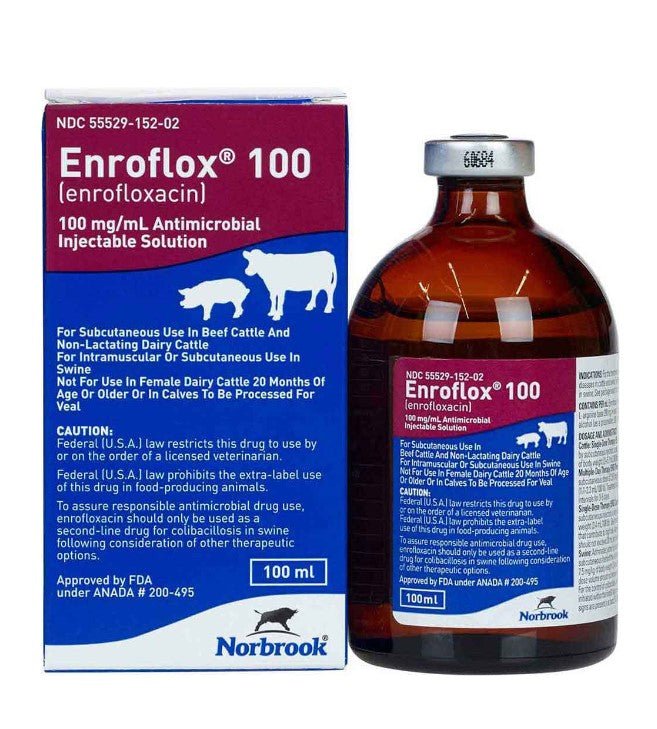
To provide rapid, concentration-dependent bactericidal action backed by rigorous veterinary clinical validation, practitioners rely on gold-standard fluoroquinolone formulations. Enroflox 100 is a premier, professional-grade injectable anti-infective powered by Enrofloxacin at a concentration of $100\ \text{mg/mL}$. Formulated as a sterile, ready-to-use aqueous solution, Enroflox 100 delivers targeted, rapid-acting antimicrobial activity engineered specifically for advanced livestock management.
Fluoroquinolone Pharmacology & Kinetic Profile
Enroflox 100 delivers a targeted biochemical mechanism engineered to inhibit essential bacterial replication enzymes and achieve rapid bactericidal concentration directly in infected tissues:
                  [Enroflox 100 Injection Administered (SC or IM in Livestock)]
                                              |
                   [Rapid Systemic Absorption and Extensive Tissue Distribution]
                                              |
               [Selective Concentration in Lung Parenchyma, Bronchi, and Target Tissues]
                                              |
               -------------------------------------------------
              |                                                 |
     [INHIBITION OF DNA TOPOISOMERASE IV]        [INHIBITION OF DNA GYRASE]
   (Halts Bacterial Chromosomal Unwinding)      (Prevents DNA Replication and Transcription)
              |                                                 |
              v                                                 v
     [Rapid Concentration-Dependent Killing]     [Suppression of Pathogenic Strains]
   (Eradicates Mannheimia, Pasteurella, etc.)   (Stops Bacterial Proliferation & Spread)
              |                                                 |
              v                                                 v
     [Systemic Clearance via Renal Excretion]    [Flexible Dosing Regimen]
   (Safe Elimination Profile Over Time)        (Single or Multi-Day Protocols Available)
              |                                                 |
               =========================> <=====================
                                              |
                                              v
                   [Complete Eradication of Target Bacterial Load & Systemic Pathogens]
                                              |
                   [Restored Herd Health, Normal Physiological Rates, & Optimized Productivity]
1. Mechanism of Action and Fluoroquinolone Structure
Enrofloxacin is a synthetic fluoroquinolone antimicrobial agent. It acts by inhibiting bacterial DNA gyrase and topoisomerase IV enzymes, which are critical for bacterial DNA replication, transcription, and repair. This dual-enzyme inhibition results in rapid, concentration-dependent bactericidal activity against a wide spectrum of Gram-negative and Gram-positive pathogens.
2. Pharmacokinetic and Tissue-Targeting Kinetics
-
Rapid Systemic Absorption: Absorbed quickly following subcutaneous or intramuscular administration, achieving high plasma concentrations almost immediately.
-
Extensive Tissue Distribution: Rapidly penetrates body tissues, concentrating heavily within the respiratory tract, lung homogenate, bronchial lining fluid, and target organs at levels exceeding concurrent plasma concentrations.
Primary Clinical Indications
Enroflox 100 is indicated across livestock production for the treatment and control of major bacterial disease complexes:
-
Bovine Respiratory Disease ($\text{BRD}$): Treatment and control of $\text{BRD}$ associated with Mannheimia haemolytica, Pasteurella multocida, Histophilus somni, and Mycoplasma bovis in beef and non-lactating dairy cattle.
-
Swine Respiratory Disease ($\text{SRD}$): Treatment and control of swine respiratory disease associated with Actinobacillus pleuropneumoniae, Pasteurella multocida, Haemophilus parasuis, and Bordetella bronchiseptica.
Recommended Administration and Dosing Protocols
To guarantee absolute safety, proper bioavailability, and tissue compatibility, Enroflox 100 must be administered strictly according to approved route and weight-based guidelines.
Dosing Reference Table
The table below outlines standard operational parameters for Enroflox 100 ($100\ \text{mg/mL}$):
| Target Species | Clinical Application Focus | Standard Dosage Rate | Administration Route & Frequency |
| Beef & Non-Lactating Dairy Cattle | Bovine Respiratory Disease ($\text{BRD}$) | $7.5$ to $12.5\ \text{mg/kg}$ ($3.4$ to $5.7\ \text{mL}$ per $100\ \text{lbs}$) | Subcutaneous ($\text{SC}$) in the neck |
| Swine | Swine Respiratory Disease ($\text{SRD}$) | $7.5\ \text{mg/kg}$ ($3.4\ \text{mL}$ per $100\ \text{lbs}$) | Intramuscular ($\text{IM}$) in the neck |
Clinical Safety, Precautions, and Storage
-
Withdrawal Periods: Observe mandatory pre-slaughter withdrawal intervals as mandated by local regulatory standards prior to marketing meat for human consumption. Do not use in female dairy cattle 20 months of age or older.
-
Cartilage Toxicity Precautions: Fluoroquinolones have been shown to cause articular cartilage erosions in weight-bearing joints and other signs of arthropathy in immature animals of various species. Use with caution in growing livestock.
-
Storage Parameters: Store unopened vials at controlled room temperatures between 15°C and 30°C (59°F to 86°F). Protect from direct sunlight and freezing.
Frequently Asked Questions (FAQ)
What is the active ingredient in Enroflox 100?
Enroflox 100 contains Enrofloxacin at a concentration of $100\ \text{mg/mL}$, functioning as a broad-spectrum fluoroquinolone antimicrobial.
What animals are approved for treatment with Enroflox 100?
It is approved for use in beef cattle, non-lactating dairy cattle, and swine for the control of severe bacterial respiratory disease complexes.
Can Enroflox 100 be used in dairy cattle intended for milk production?
It is approved for use in beef cattle and non-lactating dairy cattle, but it must not be used in female dairy cattle 20 months of age or older or in veal calves.
Where can I buy genuine Enroflox 100 online?
You can safely source authentic, pharmaceutical-grade Enroflox 100 online through Vet Pharma Med. We store all veterinary antimicrobial inventory under rigorous climate-controlled conditions to guarantee absolute product freshness, safety, and full potency.
Secure Professional Sourcing from Vet Pharma Med
At Vet Pharma Med, we understand that managing herd respiratory health and controlling acute infection outbreaks requires absolute product reliability and rigorous cold-chain standards. Every vial of Enroflox 100 is sourced through authorized veterinary distribution networks, stored in our climate-controlled facility, and handled with precision.
BRD Single Dose Therapy – Enroflox 100 may be used as single-dose therapy for treatment of BRD associated with Mannheimia haemolytica, Pasteurella multocida, Histophilus somni and Mycoplasma bovis in beef and non-lactating dairy cattle. Administer one SQ dose of 7.5-12.5 mg per kg body weight (3.4-5.7 ml per 100 lbs).
BRD Multiple Day Therapy – Enroflox 100 may be used as multiple-day therapy for treatment of BRD associated with Mannheimia haemolytica, Pasteurella multocida and Histophilus somni (previously Haemophilus somnus) in beef and non-lactating dairy cattle. Administer a daily SQ dose of 2.5-5 mg per kg body weight (1.1-2.3 ml per 100 lbs). Treatment is usually repeated at 24 hour intervals for 3 days. Additional treatments may be recommended on Days 4 and 5.
SRD Single Dose Therapy – Enroflox 100 may be used as single-dose therapy for the treatment and control of swine respiratory disease (SRD) associated with Actinobacillus pleuropneumoniae, Pasteurella multocida, Haemophilus parasuis and Streptococcus suis. Administer one SQ dose of 7.5 mg per kg body weight (3.4 ml per 100 lbs).
Do not administer more than 20 ml per injection site in cattle. Do not administer more than 5 ml per injection site in swine.
Reviews
There are no reviews yet.