
Mometamax 15g for Dogs – Otic Suspension for Canine Ear Infections
Mometamax 15g for Dogs
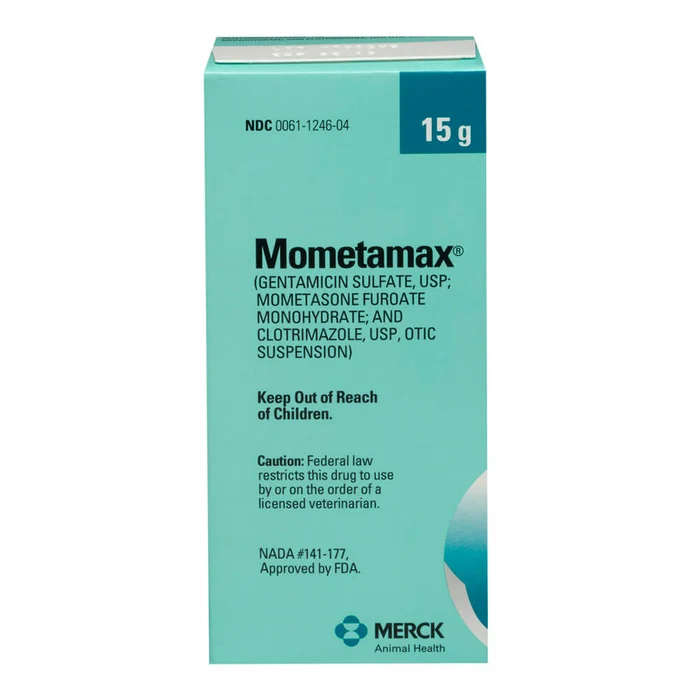
Mometamax 15g for Dogs is a prescription veterinary otic suspension formulated specifically for use in dogs. It contains three active ingredients: gentamicin sulfate, mometasone furoate, and clotrimazole. The combination provides antibacterial, antifungal, and anti-inflammatory activity for appropriate cases of canine otitis externa caused by susceptible microorganisms. The current U.S. product label identifies Mometamax as an otic suspension for dogs only and states that it is approved by the FDA under NADA #141-177.
Each gram of Mometamax contains gentamicin sulfate equivalent to 3 mg gentamicin base, mometasone furoate equivalent to 1 mg mometasone, and 10 mg clotrimazole. The product is supplied in several bottle sizes, including the 15 g bottle, making Mometamax 15g a relevant option for customers searching for the labeled canine formulation.
Mometamax is designed for the ear rather than for oral administration or general skin use. Its purpose is to provide localized treatment when a veterinarian has determined that the dog’s external ear canal has an infection involving susceptible bacteria or yeast and that the anti-inflammatory component is appropriate.
For Vet Pharma Med, a high-quality product page should clearly explain what Mometamax contains, what it is indicated for, how it is administered according to the current label, why veterinary examination matters, and how owners can safely handle an otic medication.
What Is Mometamax 15g?
Mometamax 15g is the 15-gram presentation of Mometamax Otic Suspension.
The product is a veterinary ear medication for dogs containing three active pharmaceutical ingredients:
- Gentamicin sulfate – an aminoglycoside antibiotic
- Mometasone furoate – a corticosteroid with anti-inflammatory activity
- Clotrimazole – an antifungal medication
The current product label identifies the formulation as a mineral-oil-based suspension containing a plasticized hydrocarbon gel.
This three-way formulation is one of the major characteristics that distinguishes Mometamax from single-ingredient ear products.
Rather than providing only antibacterial or only antifungal activity, the product combines antimicrobial treatment with an anti-inflammatory corticosteroid for appropriately diagnosed cases of canine otitis externa.
Mometamax Active Ingredients
Understanding the three active ingredients is important when evaluating Mometamax for Dogs.
Gentamicin
Gentamicin is an aminoglycoside antibiotic. According to the product labeling, it has activity against a range of gram-negative and gram-positive bacteria and was evaluated against organisms commonly isolated from infected canine ears, including Pseudomonas species, coagulase-positive staphylococci, Enterococcus faecalis, Proteus mirabilis, and beta-hemolytic streptococci.
Mometasone
Mometasone is a corticosteroid. Its role in the formulation is to reduce inflammatory processes associated with the affected ear.
Inflammation can contribute to redness, swelling, discomfort, and narrowing of the ear canal. Reducing inflammation can therefore be an important component of managing appropriately diagnosed otitis externa.
Clotrimazole
Clotrimazole is an antifungal medication.
The Mometamax label identifies Malassezia pachydermatis, a yeast commonly associated with canine ear disease, among the susceptible organisms for which the product is indicated.
The combination of these three ingredients gives Mometamax its antibacterial, antifungal, and anti-inflammatory profile.
What Is Mometamax Used For?
The current U.S. labeling indicates Mometamax for the treatment of otitis externa in dogs caused by susceptible strains of yeast and bacteria. Listed organisms include Malassezia pachydermatis, Pseudomonas species including P. aeruginosa, coagulase-positive staphylococci, Enterococcus faecalis, Proteus mirabilis, and beta-hemolytic streptococci.
This makes Mometamax particularly relevant to searches such as:
- Mometamax for Dogs
- Mometamax 15g
- Mometamax Otic Suspension
- Mometamax for Dog Ear Infection
- Dog Ear Infection Medicine
- Canine Otitis Externa Treatment
- Gentamicin Clotrimazole Mometasone for Dogs
- Dog Yeast Ear Infection Treatment
- Dog Bacterial Ear Infection Treatment
However, an important distinction is that Mometamax is not intended to be an automatic treatment for every ear problem.
A dog’s ear symptoms can have several different underlying causes, and veterinary examination helps determine whether the product is appropriate.
What Is Canine Otitis Externa?
Otitis externa means inflammation of the external ear canal.
It is one of the common reasons dogs develop ear discomfort and seek veterinary attention.
Affected dogs may show signs such as:
- Head shaking
- Scratching at the ears
- Redness
- Odor
- Ear discharge
- Sensitivity around the ear
- Rubbing the head against surfaces
- Changes in ear appearance
- Reluctance to have the ears handled
These signs do not by themselves establish whether the problem is bacterial, fungal, parasitic, allergic, or another type of ear disease.
A veterinarian may examine the ear canal and use diagnostic tests such as cytology to determine what organisms are present and what type of treatment is appropriate.
Mometamax for Dog Ear Infections
Mometamax is designed for certain canine ear infections involving susceptible bacteria and yeast.
Its combination formulation allows the veterinarian to address multiple components of the disease process when the diagnosis supports its use.
For example, a dog may have an inflamed external ear canal with bacterial or yeast involvement. Mometamax provides an antibiotic, antifungal, and corticosteroid in a single otic formulation.
The goal is not simply to suppress visible symptoms but to manage the diagnosed ear condition appropriately.
Mometamax for Yeast Ear Infections
Yeast can contribute to canine otitis externa.
Malassezia pachydermatis is specifically listed among the susceptible organisms in the current Mometamax labeling.
Dogs with yeast-associated ear disease may develop:
- Brown or dark ear debris
- Characteristic odor
- Redness
- Itching
- Head shaking
- Ear sensitivity
However, the appearance of ear debris alone cannot reliably identify the organism involved.
Veterinary cytology can help determine whether yeast, bacteria, or both are present.
Mometamax for Bacterial Ear Infections
The gentamicin component of Mometamax provides antibacterial activity against susceptible organisms.
The current label lists several bacteria associated with canine ear infections, including Pseudomonas, coagulase-positive staphylococci, Enterococcus faecalis, Proteus mirabilis, and beta-hemolytic streptococci.
Not every bacterial ear infection will necessarily respond to every antibiotic.
This is why veterinary diagnosis and appropriate antimicrobial selection are important, especially when infections recur or fail to respond to initial treatment.
Mometamax for Inflamed Dog Ears
Mometasone provides corticosteroid activity within the formulation.
Inflammation is a major component of many cases of otitis externa. An inflamed ear canal may become swollen and painful, and excessive inflammation can make treatment more difficult.
By including an anti-inflammatory ingredient alongside antimicrobial components, Mometamax addresses several aspects of appropriately diagnosed otitis externa.
The corticosteroid component does not mean the product should be used for every case of ear redness. The underlying cause still needs to be established.
How Mometamax Works
Mometamax combines three pharmacological actions.
Gentamicin targets susceptible bacteria by interfering with bacterial protein synthesis. The product labeling describes gentamicin as bactericidal against susceptible microorganisms.
Clotrimazole provides antifungal activity against susceptible fungi and yeast.
Mometasone provides topical corticosteroid activity to reduce inflammation.
Together, these ingredients provide a combination approach for appropriate cases of canine otitis externa.
Mometamax 15g Dosage for Dogs
According to the current U.S. label, the external ear canal should be thoroughly cleaned and dried before treatment, and the eardrum should be verified as intact.
For dogs weighing less than 30 lb, the labeled amount is 4 drops from the 7.5 g, 15 g, or 30 g bottles once daily.
For dogs weighing 30 lb or more, the labeled amount is 8 drops from the 7.5 g, 15 g, or 30 g bottles once daily.
The labeled therapy duration is 7 consecutive days.
Because Mometamax is prescription veterinary medicine, the veterinarian’s instructions and the current package label should always take precedence for the individual patient.
How to Apply Mometamax
Proper administration can help ensure that the medication reaches the intended area.
The current label specifies that the external ear canal should be thoroughly cleaned and dried before treatment. It also requires verification that the eardrum is intact.
A veterinarian may demonstrate the appropriate technique to the owner.
General handling considerations include:
- Follow the prescribed schedule.
- Shake the bottle well before use.
- Keep the bottle clean.
- Avoid contaminating the dropper tip.
- Administer only the labeled amount.
- Avoid forcing medication into an ear that is severely painful unless directed by the veterinarian.
- Complete the prescribed course unless the veterinarian changes the plan.
The current label specifically instructs users to shake well before use.
Why the Eardrum Must Be Checked
One of the most important safety points in the Mometamax label is the requirement to verify that the eardrum is intact before administration.
The external ear canal is connected to deeper structures of the ear. If the tympanic membrane is compromised, certain topical ear medications may carry additional risks.
For this reason, an owner should not simply assume that an old prescription is suitable for a new episode of ear disease.
A veterinarian should evaluate the ear before treatment when required.
Mometamax and Ear Cleaning
Cleaning the ear canal is part of the labeled administration process.
The purpose is to remove debris and material that could interfere with medication contact.
However, aggressive cleaning can irritate an already inflamed ear canal.
The veterinarian should recommend an appropriate ear-cleaning method and product for the individual dog.
Why Dogs Get Ear Infections
Canine otitis externa can have multiple contributing factors.
Potential underlying factors include:
- Allergies
- Moisture
- Ear anatomy
- Excessive hair
- Foreign material
- Parasites
- Yeast overgrowth
- Bacterial infection
- Chronic skin disease
- Hormonal or systemic conditions
A recurring ear infection may therefore be a symptom of a larger underlying problem.
Simply treating each flare-up without investigating the reason for recurrence may result in repeated episodes.
Mometamax and Allergies
Allergies can contribute to recurrent ear inflammation in dogs.
A dog may develop chronic inflammation that creates an environment favorable to secondary yeast or bacterial overgrowth.
Mometamax can address susceptible microorganisms and inflammation when its labeled use is appropriate, but it does not eliminate every underlying cause of recurrent ear disease.
If a dog repeatedly develops ear infections, veterinary investigation of allergies or other predisposing factors may be appropriate.
Recurrent Ear Infections
Repeated ear infections deserve veterinary attention.
If a dog repeatedly receives topical ear medication but the problem returns, the underlying cause may not have been fully addressed.
Possible considerations include:
- Allergic skin disease
- Persistent moisture
- Resistant organisms
- Inadequate treatment
- Incorrect diagnosis
- Ear canal changes
- Foreign bodies
- Deeper ear disease
Veterinary examination and diagnostic testing can help determine why the problem is recurring.
Mometamax and Antibiotic Stewardship
Mometamax contains gentamicin, an antibiotic.
Responsible antibiotic use is important in veterinary medicine.
Antibiotic-containing ear medication should be used when the clinical diagnosis supports it rather than being applied indiscriminately to every episode of ear itching.
Using the correct medication for the correct diagnosis can help improve treatment outcomes and support responsible antimicrobial use.
Mometamax and Antifungal Treatment
Clotrimazole provides antifungal activity in Mometamax.
This makes the product particularly relevant where susceptible yeast contributes to otitis externa.
However, the presence of yeast should ideally be confirmed through appropriate veterinary assessment rather than assumed from odor or discharge alone.
Mometamax Is Not a General Skin Cream
Mometamax is labeled as an otic suspension for dogs.
It should not automatically be used on skin lesions, facial folds, paws, or other body areas simply because a dog has an itchy or inflamed skin condition.
The approved product is specifically intended for the ear.
If another body site needs treatment, a veterinarian should recommend an appropriate product.
Mometamax for Puppies
Mometamax is a canine veterinary product, but the suitability of treatment for an individual puppy should be determined by a veterinarian.
Puppies can have different health considerations from adult dogs, and ear disease may require examination to determine the underlying cause.
Owners should not reuse medication prescribed for another dog or another episode without veterinary guidance.
Mometamax for Small Dogs
The labeled dosage differentiates dogs below 30 lb from dogs weighing 30 lb or more.
For bottles of 7.5 g, 15 g, and 30 g, the current label specifies 4 drops once daily for dogs under 30 lb.
Accurate body weight therefore matters when following the label.
Mometamax for Large Dogs
For dogs weighing 30 lb or more, the current U.S. label specifies 8 drops once daily when using the 7.5 g, 15 g, or 30 g bottle presentations.
The veterinarian should confirm that the product is appropriate and that the dog’s condition matches the labeled indication.
Mometamax 15g Storage
The current label instructs users to store Mometamax between 2°C and 25°C (36°F and 77°F). It also states that the product should be used within 28 days after first use.
Always follow the current package label because storage requirements can be specific to the formulation.
Keep the bottle out of reach of children and animals that are not receiving the medication.
How Long Is Mometamax Used?
The current U.S. label specifies 7 consecutive days of therapy.
Owners should not extend treatment independently.
If the ear remains painful, inflamed, or infected after the prescribed treatment period, the veterinarian should reassess the dog rather than automatically continuing medication.
What Happens If the Ear Does Not Improve?
Failure to improve may indicate:
- The organism is not susceptible.
- The underlying cause has not been addressed.
- The diagnosis needs reassessment.
- The infection is deeper than the external ear.
- There is a foreign body.
- There is an anatomical problem.
- The ear canal is severely inflamed or damaged.
- Another disease is contributing to the problem.
The appropriate next step is veterinary reassessment.
Mometamax Side Effects
The current product labeling reports adverse observations from field studies.
Following once-daily treatment, ataxia, proprioceptive deficits, and increased water consumption were observed in less than 1% of 164 dogs. In a separate twice-daily field study, inflammation of the pinna and diarrhea were observed in less than 1% of 141 dogs.
Owners should contact a veterinarian if their dog develops unexpected or significant symptoms while receiving treatment.
Signs Requiring Prompt Veterinary Attention
A dog with an ear problem should receive prompt veterinary attention if there is:
- Severe ear pain
- Sudden loss of balance
- Head tilt
- Marked swelling
- Significant discharge
- Blood from the ear
- Hearing changes
- Facial weakness
- Persistent vomiting
- Severe worsening after treatment
These signs may indicate disease beyond uncomplicated external otitis and should not be managed solely through online product information.
Mometamax and Vestibular Signs
The ear contains structures involved in balance.
A dog that develops head tilt, loss of balance, unusual eye movements, or difficulty walking during an ear problem requires veterinary evaluation.
These signs can indicate deeper ear involvement.
Do not assume that simply increasing or extending Mometamax treatment will resolve such symptoms.
Mometamax and Hearing
Ear infections can affect hearing, particularly when the canal is severely inflamed or when deeper ear structures become involved.
Veterinary evaluation helps determine whether the problem is limited to the external ear or involves deeper structures.
The requirement to verify that the eardrum is intact before Mometamax treatment is therefore particularly important.
Mometamax Prescription Status
Mometamax is a prescription animal drug.
The current product label states that federal law restricts the medication to use by or on the order of a licensed veterinarian.
Vet Pharma Med should therefore present the product as prescription veterinary medicine and avoid implying that it is an unrestricted over-the-counter ear treatment.
Mometamax 15g Online
Customers searching for Mometamax 15g online may be looking for the specific 15 g bottle presentation.
The current label confirms that Mometamax is available in 7.5 g, 15 g, 30 g, and 215 g presentations.
When purchasing prescription veterinary medication online, customers should verify:
- Correct product name
- Correct bottle size
- Intended species
- Active ingredients
- Prescription requirements
- Manufacturer
- Expiration date
- Packaging integrity
- Storage conditions
Mometamax Manufacturer
The current U.S. label identifies Merck Sharp & Dohme Corp. as the packager and states that the product is distributed by Intervet Inc., doing business as Merck Animal Health.
This information can help customers distinguish the product from similarly named or unrelated ear medications.
Mometamax Versus Single-Ingredient Ear Products
One advantage of a combination formulation is that it can address multiple components of appropriately diagnosed otitis externa.
Mometamax combines:
Antibiotic: Gentamicin
Antifungal: Clotrimazole
Anti-inflammatory corticosteroid: Mometasone
This makes it different from products containing only an antibiotic, only an antifungal, or only an anti-inflammatory agent.
The correct choice depends on the veterinarian’s diagnosis.
Mometamax and Canine Ear Odor
Strong ear odor is frequently associated with canine ear disease.
However, odor alone cannot identify the specific cause.
Yeast, bacteria, accumulated debris, inflammation, and other conditions can contribute to abnormal ear odor.
Mometamax should therefore be used when the veterinary diagnosis supports its labeled indication rather than simply because the ear smells unpleasant.
Mometamax and Ear Discharge
Ear discharge can vary considerably.
It may appear:
- Brown
- Yellow
- Dark
- Greasy
- Moist
- Thick
- Bloody
The appearance of discharge is not enough to determine whether the infection is bacterial or fungal.
Veterinary examination and diagnostic testing can provide more reliable information.
Why Cytology Can Matter
Veterinary ear cytology can help identify yeast and bacterial organisms in ear debris.
This information can help the veterinarian determine whether a product such as Mometamax is appropriate.
Cytology can also help monitor recurrent infections and identify cases where a different approach may be necessary.
Mometamax for Malassezia
Malassezia pachydermatis is specifically included among the susceptible yeast organisms listed on the Mometamax label.
This makes “Mometamax for Malassezia in dogs” a relevant informational search phrase.
However, responsible product content should distinguish an approved indication from a guarantee of success in every individual infection.
Mometamax for Pseudomonas
The current labeling lists Pseudomonas species, including Pseudomonas aeruginosa, among susceptible bacterial organisms.
Pseudomonas-associated ear infections can be challenging and may require veterinary testing and careful treatment.
Owners should not assume that any chronic or severe ear infection is caused by Pseudomonas.
Mometamax and Staphylococci
Coagulase-positive staphylococci are among the bacteria listed in the product labeling.
This is another reason Mometamax can be relevant to canine bacterial otitis externa when the causative organism is susceptible.
Mometamax and Proteus
Proteus mirabilis is also listed among the susceptible bacterial organisms in the U.S. label.
Again, susceptibility does not mean every ear infection caused by every strain will respond identically.
Veterinary diagnosis remains important.
Mometamax and Enterococcus
The label identifies Enterococcus faecalis among organisms for which gentamicin activity was evaluated and which are included in the labeled indication.
This detailed organism information can be useful for customers researching the product and for creating accurate SEO content around veterinary otic medications.
Mometamax for Dogs in the USA
For U.S. customers, the current product labeling identifies Mometamax as an FDA-approved prescription animal drug under NADA #141-177.
Product availability and prescription requirements can vary by jurisdiction.
A U.S.-focused product page should therefore use accurate regulatory language and avoid suggesting that the U.S. regulatory status automatically applies internationally.
International Mometamax Searches
Customers outside the United States may search using terms such as:
- Mometamax for Dogs Canada
- Mometamax for Dogs Australia
- Mometamax for Dogs Europe
- Mometamax for Dogs France
- Mometamax for Dogs Germany
- Mometamax for Dogs Spain
- Mometamax for Dogs Netherlands
- Mometamax for Dogs Mexico
International customers should verify the local regulatory status, prescription requirements, approved labeling, and availability applicable to their country.
The U.S. label is useful for describing the U.S. formulation, but it should not be presented as universal regulatory guidance.
Mometamax for Veterinary Use
Mometamax is best understood as a targeted veterinary otic medication.
The three active ingredients provide complementary actions, but successful management of ear disease depends on identifying the underlying cause.
A good veterinary treatment plan may include:
- Otoscopic examination
- Ear cytology
- Ear cleaning
- Appropriate topical medication
- Management of underlying allergies
- Follow-up examination
- Longer-term prevention where necessary
Responsible Use of Mometamax
Responsible use means following the veterinary prescription and current label.
Owners should not:
- Share Mometamax between dogs.
- Use leftover medication for a new ear problem without veterinary advice.
- Use it after the recommended post-opening period.
- Put it in an ear without checking whether it is appropriate.
- Continue treatment beyond the prescribed period without reassessment.
- Use it in another animal species unless specifically directed by a veterinarian.
These practices help reduce avoidable medication errors.
Why a Veterinary Examination Is Important
A dog’s ear canal can become swollen and painful very quickly.
A veterinarian can determine:
- Whether the tympanic membrane is intact
- Whether the infection is external or deeper
- Whether bacteria or yeast are present
- Whether a foreign body is present
- Whether allergies are contributing
- Whether a different medication is needed
This is particularly important when the ear infection is severe or recurrent.
Mometamax 15g Product Summary
Mometamax 15g is a 15-gram bottle presentation of Mometamax Otic Suspension for dogs.
Its formulation contains:
Gentamicin sulfate: antibacterial activity
Mometasone furoate: corticosteroid anti-inflammatory activity
Clotrimazole: antifungal activity
The current U.S. label indicates the product for canine otitis externa caused by susceptible bacteria and yeast.
The combination makes Mometamax a distinctive option among prescription canine ear medications.
Frequently Asked Questions About Mometamax 15g for Dogs
What is Mometamax 15g for Dogs?
Mometamax 15g is a 15-gram presentation of Mometamax Otic Suspension, a prescription veterinary ear medication for dogs containing gentamicin, mometasone, and clotrimazole.
What is Mometamax used for?
It is labeled for treatment of canine otitis externa caused by susceptible strains of certain bacteria and yeast.
What are the active ingredients in Mometamax?
Mometamax contains gentamicin sulfate, mometasone furoate, and clotrimazole. Each gram contains quantities equivalent to 3 mg gentamicin base, 1 mg mometasone, and 10 mg clotrimazole.
Is Mometamax an antibiotic?
Mometamax contains gentamicin, which is an antibiotic, but the product is a combination medication that also contains an antifungal and corticosteroid.
Is Mometamax an antifungal?
Yes. It contains clotrimazole, an antifungal ingredient.
Does Mometamax contain a steroid?
Yes. It contains mometasone furoate, a corticosteroid used to reduce inflammation.
Does Mometamax treat yeast infections in dogs’ ears?
Mometamax is labeled for otitis externa caused by susceptible strains of Malassezia pachydermatis.
Does Mometamax treat bacterial ear infections?
It is labeled for canine otitis externa caused by several susceptible bacteria, including certain Pseudomonas, staphylococci, Enterococcus, Proteus, and beta-hemolytic streptococci.
How much Mometamax should I give my dog?
The current U.S. label specifies 4 drops once daily for dogs under 30 lb and 8 drops once daily for dogs 30 lb or more when using the 7.5 g, 15 g, or 30 g bottle. Treatment is labeled for 7 consecutive days.
Follow your veterinarian’s specific instructions.
Does Mometamax need to be shaken?
Yes. The current label states shake well before use.
Should the dog’s ear be cleaned before Mometamax?
Yes. The current label instructs that the external ear canal should be thoroughly cleaned and dried before treatment.
Does the eardrum need to be checked?
Yes. The label instructs that the eardrum should be verified as intact before treatment.
How long is Mometamax used?
The current U.S. label specifies 7 consecutive days of therapy.
Can I use Mometamax for another dog?
Do not share prescription medication between animals without veterinary direction. The diagnosis and appropriate treatment can differ between dogs.
Can I use leftover Mometamax?
It is better to have the dog’s current ear problem evaluated rather than automatically using leftover medication. The cause may be different, and the current label requires the eardrum to be verified as intact before treatment.
Can Mometamax be used in cats?
The current U.S. label specifically states “For Otic Use in Dogs Only.”
Do not use it in cats unless a veterinarian specifically directs an appropriate treatment.
How should Mometamax 15g be stored?
The current label states storage between 2°C and 25°C (36°F and 77°F) and instructs users to use the product within 28 days of first use.
Is Mometamax prescription-only?
Yes. The current label states that federal law restricts the medication to use by or on the order of a licensed veterinarian.
What if my dog’s ear gets worse during treatment?
Contact the veterinarian. Severe pain, head tilt, balance problems, sudden hearing changes, significant swelling, or other worsening symptoms can require reassessment.
Can Mometamax treat every dog ear infection?
No. It is indicated for otitis externa caused by susceptible bacteria and yeast listed in the label. Other causes may require different treatment.
Final Product Description
Mometamax 15g for Dogs is a prescription veterinary otic suspension formulated for the treatment of appropriate cases of canine otitis externa. The 15 g presentation contains the same three active ingredients as the other standard Mometamax bottle presentations: gentamicin sulfate, mometasone furoate, and clotrimazole.
The combination provides three complementary actions. Gentamicin provides antibacterial activity against susceptible organisms, clotrimazole provides antifungal activity, and mometasone helps manage inflammation associated with the affected ear.
The current U.S. labeling specifically identifies susceptible strains of Malassezia pachydermatis, Pseudomonas species including P. aeruginosa, coagulase-positive staphylococci, Enterococcus faecalis, Proteus mirabilis, and beta-hemolytic streptococci.
Mometamax is intended for otic use in dogs only. Before treatment, the current label instructs that the external ear canal should be thoroughly cleaned and dried and that the eardrum should be verified as intact. For the 7.5 g, 15 g, and 30 g presentations, the labeled administration is 4 drops once daily for dogs weighing less than 30 lb and 8 drops once daily for dogs weighing 30 lb or more, with therapy continuing for 7 consecutive days.
Mometamax should be used only according to veterinary direction. Ear infections can have different causes, and recurring or severe disease may require additional diagnostic evaluation. A veterinarian can determine whether the infection involves susceptible bacteria or yeast and whether the external ear is the only part of the ear affected.
For customers researching Mometamax 15g for Dogs, Mometamax Otic Suspension, Mometamax for dog ear infections, gentamicin for dogs’ ears, clotrimazole for canine ears, mometasone ear medication for dogs, and canine otitis externa treatment, Vet Pharma Med can provide a detailed product resource while maintaining accurate, responsible veterinary information.
Mometamax is an established prescription veterinary ear medication, but it should not be presented as a universal solution for every canine ear problem. The strongest product information combines accurate ingredient details, labeled indications, administration information, safety considerations, and practical guidance about veterinary diagnosis and follow-up.
Reviews
There are no reviews yet.